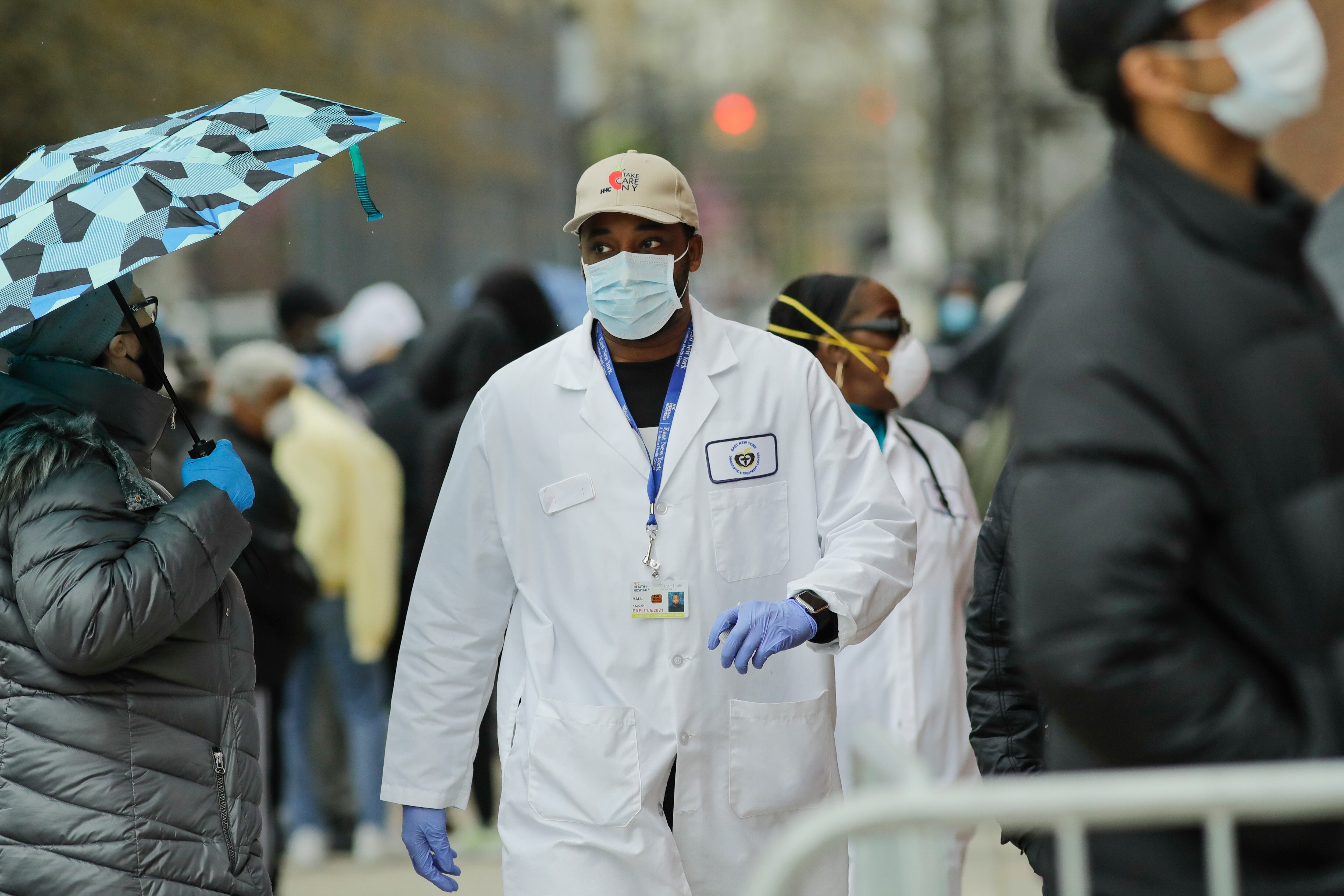
More evidence is emerging that far more New Yorkers have had the coronavirus than the number confirmed by lab tests, officials said Thursday.
A state survey of about 3,000 people found that nearly 14% had antibodies, suggesting they had been exposed to the virus, Gov. Andrew Cuomo said at his daily news briefing.
In New York City, the epicenter of the pandemic in the U.S., 21% of the people tested had antibodies.
Cuomo cautioned that the data was preliminary. The sample of people tested was small. Participants were hastily recruited at shopping centers and grocery stores, which meant they were healthy enough to be out in public.
But the governor said knowing how many people have antibodies, and who might possibly be immune to the virus, could potentially help set policy on when to reopen parts of the state.
“We’ll have a larger and larger sample. But I want to see snapshots of what is happening with that rate. Is it going up, is it flat, is it down? And it can really give us data to make decisions," Cuomo said.
Earlier Thursday, New York City's health commissioner said many as 1 million people in New York City may have been exposed to the coronavirus.
At least 263,000 people statewide, including about 142,000 people in New York City, have tested positive for the coronavirus, but city Health Commissioner Dr. Oxiris Barbot called those numbers “the tip of the iceberg.”
She noted the city is still telling people who suspect they have the virus but aren’t seriously ill that they don’t need to seek a test, so the true number of sick people is unknown.
“It wouldn’t surprise me if, at this point in time, we have probably close to 1 million New Yorkers who have been exposed to COVID-19,” she said.
Another 438 people were killed by the virus in the state Wednesday, bringing its total death toll to more than 15,700. That number doesn't include more than 5,100 other deaths in New York City that were believed to be caused by the virus but haven't been confirmed by a lab test.
More than 15,000 people remain hospitalized statewide, with nearly 1,400 new patients admitted each day over the past few days.
Blood tests that check for antibodies, substances the immune system makes to fight the virus, are expected to allow health officials to better understand how many people had the virus with few or no symptoms.
New York's attempt to get a picture of how many people have virus antibodies is also driven by wanting to know if the region is closer to achieving herd immunity, a state in which so many people have developed defenses against the infection that it becomes hard for the virus to spread.
But such tests need to be done with random sampling, ensuring that the people being tested are representative of geographic, social, racial and other conditions. There are also questions about the accuracy of the blood tests being used. Scientists have found that some of them aren’t reliable enough, with too many false positives and false negatives.
Experts also don't yet know whether having antibodies means someone won’t get COVID-19 a second time.
New York's antibodies survey was done at 40 locations in 19 counties. Relatively few people were found with antibodies, just 3.6%, in areas of upstate New York.
Early on in the pandemic, health officials estimated that as many as half of all people in New York City would get the virus. Mayor Bill de Blasio said that’s still plausible, though the lack of comprehensive, widespread testing makes it difficult to say for sure.
“We are still dealing with the great unknown in the absence of testing. We don’t even 100 percent know when the first cases emerged in this city, because we didn’t have testing in February. We know it was February, but we don’t know how many people got it back then.”
De Blasio said that “in a perfect world" hundreds of thousands of people a day would be tested.
He said the city needs help from the federal government to reach that level of testing but is building testing capacity and should reach 20,000 to 30,000 tests a day by next month.
___
This story has been corrected to show that 263,000 people in New York state have tested positive for the coronavirus, not just in New York City.