By Joseph Krauss and Wafaa Shurafa
Palestinians lined up outside bakeries and grocery stores in Gaza on Thursday after spending the night surrounded by the ruins of pulverized neighborhoodsdarkened by a near-total power outage. Israel launched new airstrikes and said it was preparing for a possible ground invasion.
International aid groups warned that the death toll in Gaza could mount after Israel stopped all deliveries of food, water, fuel and electricity and the tiny enclave's crossing with Egypt closed. The war — which was ignited by a bloody and wide-ranging assault on Israel by Hamas militants — has already claimed at least 2,500 lives on both sides.
Lt. Col. Richard Hecht, an Israeli military spokesman, told reporters Thursday that forces “are preparing for a ground maneuver if decided," but that political leaders have not yet ordered one. A ground offensive in Gaza, whose 2.3 million residents are densely packed into a sliver of land only 40 kilometers (25 miles) long, would likely bring even higher casualties on both sides in brutal house-to-house fighting.
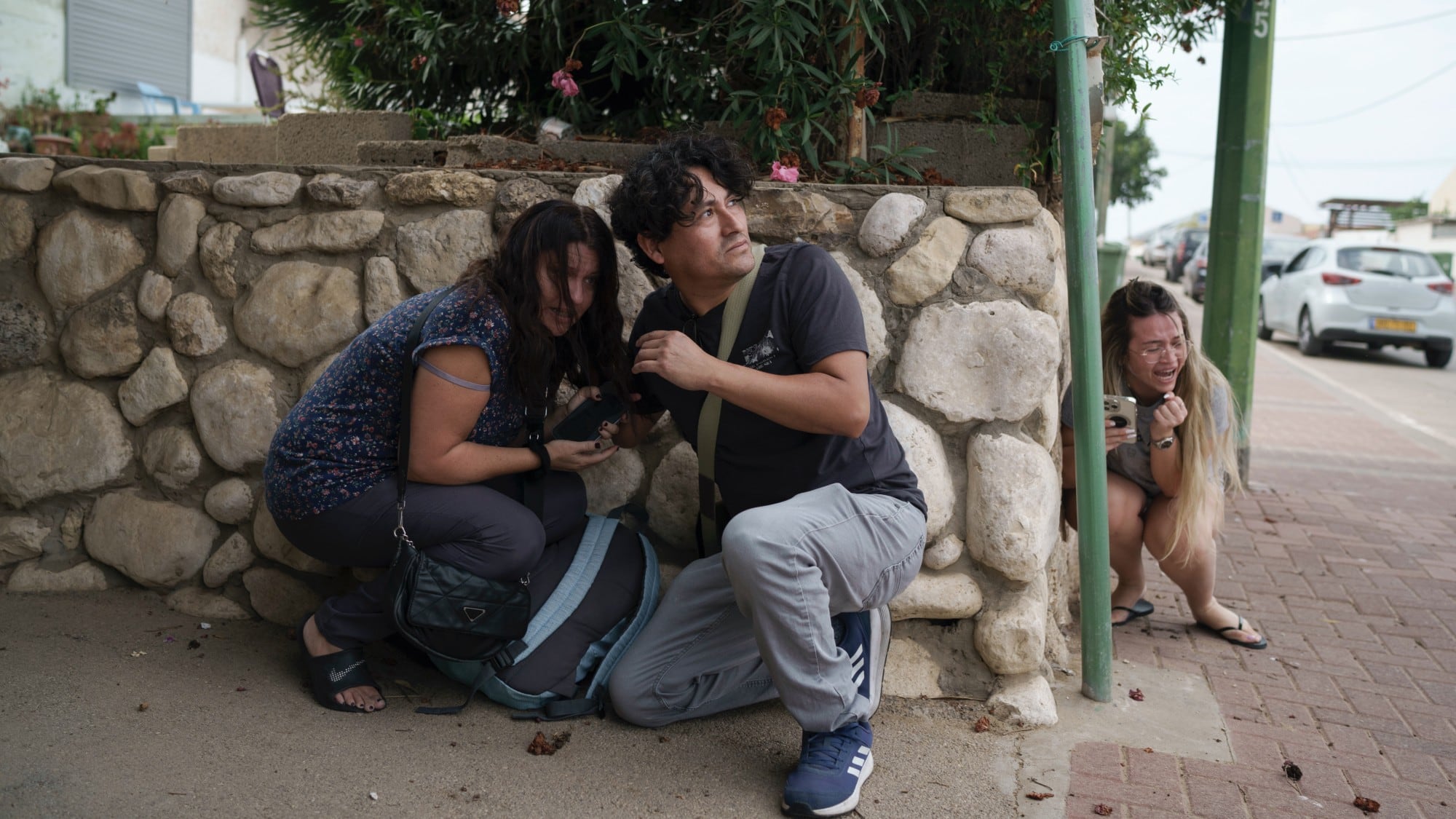
As Israel pounds Gaza, Hamas fighters have fired thousands of rockets into Israel since their weekend assault. Militants in the territory are also holding an estimated 150 people taken hostage from Israel.
Already, Palestinians fleeing airstrikes could be seen running through the streets, carrying their belongings and looking for a safe place. Tens of thousands have crowded into U.N.-run schools while others are staying with relatives or even strangers who let them in.
Lines formed outside bakeries and grocery stores during the few hours they dared open, as people tried to stock on food before shelves are emptied. On Wednesday, Gaza’s only power station ran out of fuel and shut down, leaving only lights powered by scattered private generators.
A senior official with the the International Committee of the Red Cross warned that lack of electricity could cripple hospitals.
“As Gaza loses power, hospitals lose power, putting newborns in incubators and elderly patients on oxygen at risk. Kidney dialysis stops, and X-rays can’t be taken,” said Fabrizio Carboni, ICRC’s regional director. “Without electricity, hospitals risk turning into morgues.”
Israel’s Energy Minister Israel Katz said nothing would be allowed into Gaza until the captives were released. “Not a single electricity switch will be flipped on, not a single faucet will be turned on, and not a single fuel truck will enter until the Israeli hostages are returned home,” he tweeted.
After Hamas militants stormed through a border fence Saturday and massacred hundreds of Israelis in their homes, on the streets and at an outdoor music festival, Israeli Prime Minister Benjamin Netanyahu vowed to “crush and destroy” the group, which has governed Gaza since 2007.
“Every Hamas member is a dead man,” Netanyahu said in a televised address late Wednesday.
The Israeli government is under intense public pressure to topple the militant group rather than continuing to try to bottle it up in Gaza after four previous conflicts ended with Hamas still firmly in charge of the territory. Israel has mobilized 360,000 reservists, massed additional forces near Gaza and evacuated tens of thousands of residents from nearby communities.
Netanyahu now has the backing of a new war Cabinet that includes a longtime opposition politician. The U.S. has also pledged unwavering support, and Secretary of State Antony Blinken arrived in Tel Aviv on Thursday to meet with Netanyahu and other Israeli leaders. He plans to meet Friday with Palestinian President Mahmoud Abbas and Jordan’s King Abdullah II.
The Israeli military said overnight strikes targeted Hamas' elite Nukhba forces, including command centers used by the fighters who attacked Israel on Saturday, and the home of a senior Hamas naval operative that it said was used to store unspecified weapons.
Another airstrike killed a commander with the Islamic Jihad armed group in his family home in the northern town of Beit Lahia, according to media linked to the group. And a commander from a small, leftist militant group was also killed in a strike, along with some of his relatives, the group's media said.
“Right now we are focused on taking out their senior leadership,” Hecht, the military spokesman, said. "Not only the military leadership, but also the governmental leadership, all the way up to (top Hamas leader Yehia) Sinwar. They were directly connected."
The Hamas-run Interior Ministry said Israeli strikes demolished two multistory houses without warning, killing and wounding “a large number” of people, mainly civilians. Hamas has threatened to kill hostages if Israel strikes Palestinian civilians without warning.
While Israel has insisted that it is giving notice of its strikes, it is employing a new tactic of leveling whole neighborhoods, rather than just individual buildings.
Israel’s tone has changed as well. In past conflicts, its military insisted on the precision of strikes in Gaza, trying to ward off criticism over civilian deaths. This time, military briefings emphasize the destruction wrought.
Hecht said Israel was not “doing carpet bombing, though some people would like to see that.” He said targeting decisions were based on intelligence and civilians were warned.
Even with the evacuation warnings, Palestinians say some are unable to escape or have nowhere to go, and that entire families have been crushed under rubble.
Other times, strikes come with no notice, survivors say.
“There was no warning or anything,” said Hashem Abu Manea, 58, who lost his 15-year-old daughter, Joanna, when a strike late Tuesday leveled his home in Gaza City.
The U.N. said late Wednesday the number of people displaced by the airstrikes had soared 30% within 24 hours, to 339,000, two-thirds of them crowding into U.N. schools. Others sought shelter in the shrinking number of safe neighborhoods.
The U.N. humanitarian office said Israeli strikes have leveled 1,000 homes since the retaliation began last Saturday, with another 560 housing units severely damaged and rendered uninhabitable. It said an Israeli cutoff has resulted in dire water shortages for over 650,000 people. Sewage systems have been destroyed, sending fetid wastewater into the streets.
Egypt has engaged in intensive talks with Israel and the United States to allow the delivery of aid and fuel through its Rafah crossing point, which is closed after an airstrike hit nearby earlier this week.
But it has pushed back against proposals to establish corridors out of Gaza, saying an an exodus of Palestinians would have grave consequences for their hopes of one day establishing an independent state. Egypt is also likely concerned about a potential influx of hundreds of thousands of displaced people.
The death toll in Gaza rose to 1,200 early Thursday, including at least 326 children and 171 women, the Palestinian health ministry said.
Ghassan Abu Sitta, a reconstructive surgeon at the Gaza Strip’s biggest hospital, said he had 50 patients waiting to go to the operating room.
“We’re already beyond the capacity of the system to cope,” he said. The health system “has the rest of the week before it collapses, not just because of the diesel. All supplies are running short.”
Shock, grief and demands for vengeance against Hamas are running high in Israel.
Netanyahu alleged that the attackers engaged in atrocities, including binding boys and girls and shooting them in the head, burning people alive, raping women and beheading soldiers.
The prime minister’s allegations could not be independently confirmed. Rescue workers and witnesses have described horrifying scenes, including the slaughter of elderly people and finding bloody rooms crowded with massacred civilians.
The Israeli military said more than 1,300 people, including 222 soldiers, have been killed in Israel, a staggering toll unseen since the 1973 war with Egypt and Syria that lasted weeks.
Israel says roughly 1,500 Hamas militants were killed inside Israel, and that hundreds of the dead inside Gaza are Hamas members.
Shurafa reported from Gaza City, Gaza Strip. Associated Press writers Amy Teibel and Isabel DeBre in Jerusalem; Sam McNeil in Be'eri, Israel; Jack Jeffrey and Samy Magdy in Cairo; and Kareem Chehayeb in Beirut contributed to this report.