By Seung Min Kim, Jill Lawless and Chris Megerian
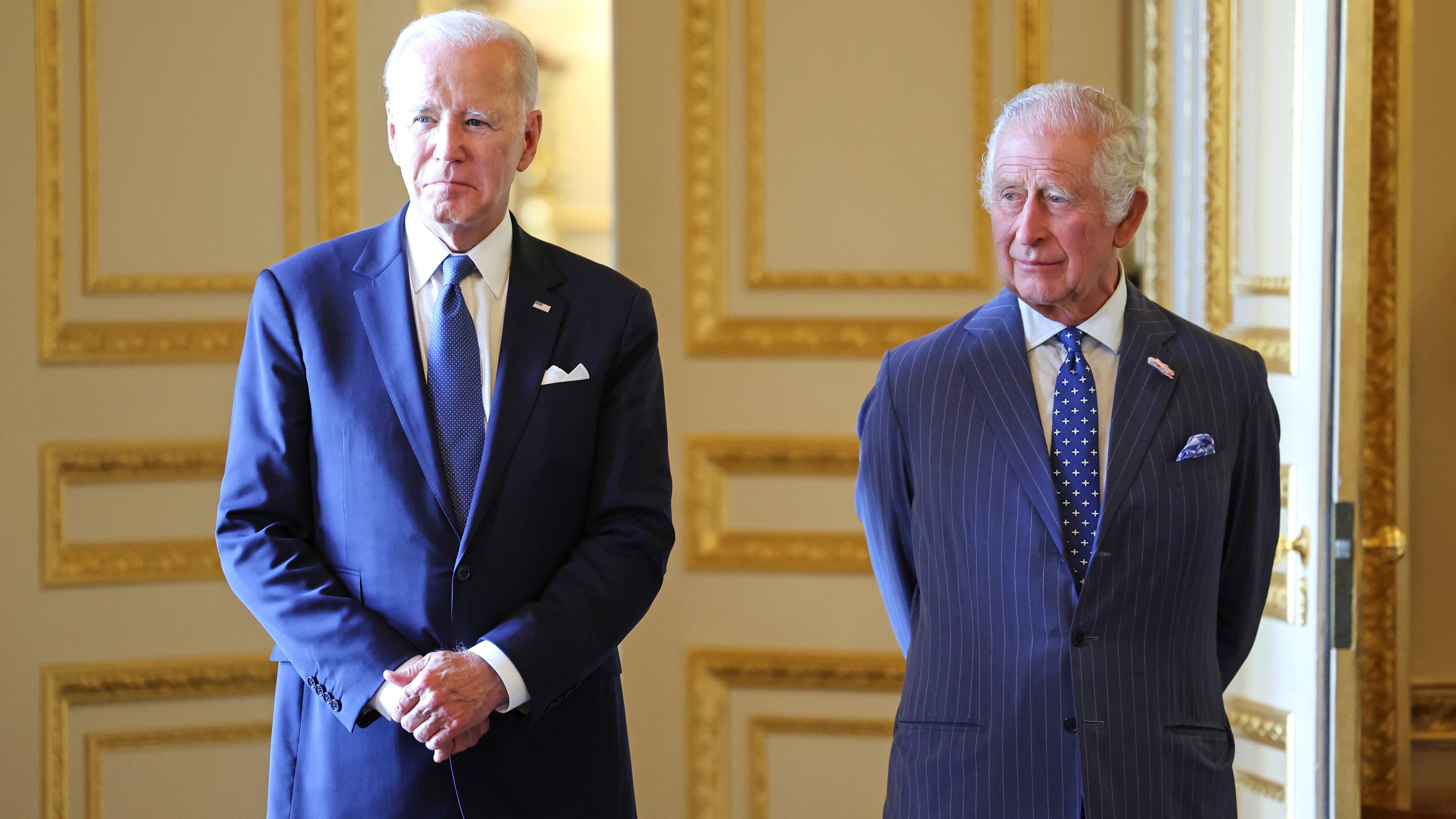
President Joe Biden and King Charles III, two leaders who waited decades to reach the pinnacle of their careers, used their first meeting in those roles Monday to zero in on the generational challenge of climate change, prodding private companies to do more to bolster clean energy in developing countries.
The meticulously choreographed gathering at Windsor Castle injected substance into the type of encounter between president and monarch that historically has been more about ceremony. After the arrival formalities, Biden and Charles participated in a climate-focused roundtable with officials from the financial and philanthropic sectors. John Kerry, the U.S. envoy on climate, also attended.
The 74-year-old Charles, who was crowned in May, has long fought to protect wildlife and battle climate change. Biden, for his part, identified climate change as one of the four crises he was determined to confront as president. He signed a sweeping legislative package last year that includes nearly $375 billion in climate-related incentives.
Biden, 80, last had formal talks with Charles, then prince, at the COP26 U.N. climate summit in Glasgow, Scotland, in November 2021. The U.S. president also attended the state funeral of Charles’s mother, Queen Elizabeth II, in September as well as a reception for heads of state at Buckingham Palace the night before the service. Biden did not attend Charles’s coronation, sending first lady Jill Biden instead.
Jake Sullivan, the White House national security adviser, said the president has “huge respect” for the king’s commitment on the climate issue in particular. He said Charles has been a “clarion voice” on climate and “someone who’s mobilized action and effort.”
Biden and Charles made sure to show off their still-developing friendship and warmth during the ceremonial arrival at Windsor Castle, outside London. After they shook hands, Biden put his hand on Charles's arm, then on the king's back as they approached a viewing platform to inspect an honor guard. They appeared relaxed and cordial — a contrast to more formal encounters between past U.S. presidents and British royalty. Biden and Charles discussed climate, China and shared stories from the past during their visit, according to Sullivan.
The views of the late Queen Elizabeth II on politics and political issues were a closely guarded secret, and her meetings with world leaders were almost entirely ceremonial. Charles spent his decades as heir to the throne expressing opinions on issues from architecture to the environment, and has continued to take a keen interest in climate change now that he is king. However, neither he nor Biden spoke publicly at Windsor Castle.
Biden's royal visit was paired with his sixth meeting with the British prime minister since Rishi Sunak took office, The two discussed a range of global issues, including the war in Ukraine. Both nations are among the most stalwart defenders of Kyiv, and the United Kingdom has pushed the White House to take more aggressive steps in providing military aid to Ukraine.
Following his meetings with Charles and Sunak, Biden flew to Vilnius, Lithuania, for the annual NATO summit. Discussion about the war in Ukraine is expected to be front-and-center over two days of talks that begin Tuesday.
His talks with Charles were meant to highlight the so-called enduring “special relationship” between the U.S. and the U.K. When Biden declined to attend Charles’s coronation, he promised the king in a phone call that he would visit soon.
Biden's meeting with Sunak at the prime minister's residence at 10 Downing St. included discussion about the U.S. president’s decision this week to provide Ukraine with cluster munitions, a weapon that more than two-thirds of the members of the NATO military alliance have barred for their potential threat to civilian life.
Biden has said that providing the bombs — which open mid-air and release smaller “bomblets” across a broad swath of land — was a “difficult decision” but he noted that the Ukrainians are running out of ammunition and that the weapons were necessary for them to continue to fight Russian forces.
“It took me a while to be convinced to do it,” Biden said in a CNN interview broadcast as he flew to London. “But the main thing is, they either have the weapons to stop the Russians ... from stopping the Ukrainian offensive through these areas, or they don’t. And I think they needed them.”
Sunak, for his part, has distanced himself from the U.S. decision. The prime minister's spokesman said the leaders spoke Monday about Britain’s opposition to the use of cluster munitions.
“The first thing to say is this was a difficult choice for the U.S. that has been forced on them by Russia’s war of aggression,” said Sunak’s spokesman, Max Blain. “As the prime minister said over the weekend, the U.K. is a state party to the convention on cluster munitions. They discussed the commitments the U.K. has under that convention both not to produce or use cluster munitions and to discourage their use.”
The U.S. is not a party to that agreement. Sunak stressed over the weekend that Britain will “continue to do our part to support Ukraine against Russia’s illegal and unprovoked invasion, but we’ve done that by providing heavy battle tanks and most recently long-range weapons, and hopefully all countries can continue to support Ukraine.”
Sunak told Biden during their meeting that he understood that providing the cluster munitions was a difficult decision for Biden, and that he recognized the U.S.’s rationale for doing so, according to a White House official who was granted anonymity to discuss a private conversation.
Sullivan also played down the disagreement over cluster munitions, saying, “I think you will find Prime Minister Sunak and President Biden on the same page strategically on Ukraine, in lockstep on the bigger picture of what we're trying to accomplish and as united as ever — both in this conflict and writ large.”
And as the leaders met over tea in the 10 Downing St. garden on Monday, they continued to project that face of unity.
“We've only been meeting once a month,” Biden joked as he declared the relationship between the U.S. and U.K. was “rock solid.” Sunak added that their countries are “two of the firmest allies in that alliance.”
Associated Press writer Darlene Superville in Washington contributed to this report.