By Will Weissert, Philip Marcelo, and Aamer Madhani
President-elect Joe Biden on Monday cheered news about the promising development of a coronavirus vaccine but cautioned Americans need to be aggressive about mask wearing and social distancing as infections continue to surge around the country.
The Democrat's transition team also unveiled members of Biden's coronavirus working group tasked with developing his administration's pandemic response — something Biden says he wants to put in motion as soon as he takes office in January.
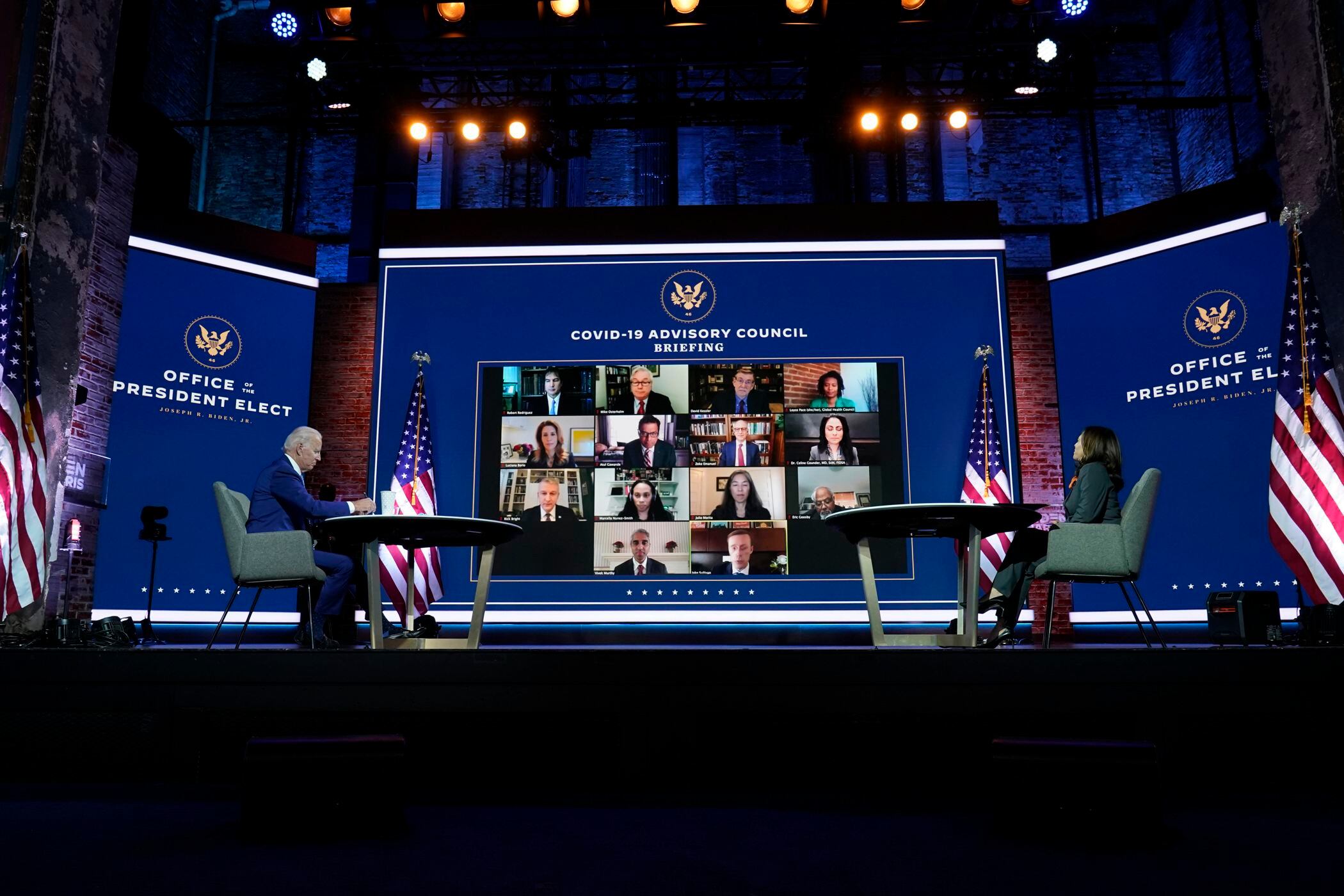
As Biden unveiled his coronavirus advisory board — led by former Surgeon General Dr. Vivek Murthy, former Food and Drug Administration Commissioner David Kessler and Yale University public health care expert Dr. Marcella Nunez-Smith — Pfizer announced promising results from a vaccine trial.
The company, which developed the vaccine with the German drugmaker BioNTech, said it is on track to file an emergency use application with U.S. regulators later this month.
“Even if that is achieved, and some Americans are vaccinated later this year, it will be many more months before there is widespread vaccination in this country," Biden said in a statement, noting that the vaccine does not change the “urgent reality" that Americans will have to rely on masking, distancing, and other mitigation in the months ahead.
Biden is set to take the reins as the pandemic climbs to a new apex. Over the past two weeks, the number of confirmed COVID-19 cases has risen nearly 65%: the 7-day rolling average for daily new cases in the U.S. went from 66,294 on Oct. 25 to 108,736.7 on Nov. 8.
In the past week, 1 out of every 433 Americans was diagnosed with COVID-19. Hospitals in several states are running out of space and staff, and the death toll is soaring. So far, the U.S. has recorded more than 9.8 million infections and more than 237,000 deaths from COVID-19.
Biden and Vice President-elect Kamala Harris received a briefing from the newly-formed advisory board on Monday morning and Biden plans to deliver an address on the pandemic after the meeting.
While Biden greeted the news with cautious optimism, President Donald Trump took to Twitter to herald the moment with all caps exuberance: “STOCK MARKET UP BIG, VACCINE COMING SOON. REPORT 90% EFFECTIVE. SUCH GREAT NEWS!"
An interim analysis of the Pfizer vaccine, from an independent data monitoring board, looked at 94 infections recorded so far in a study that has enrolled nearly 44,000 people in the U.S. and five other countries.
Pfizer says an early peek at its vaccine data suggests the shots may be 90% effective at preventing COVID-19, indicating the company is on track later this month to file an emergency use application with U.S. regulators.
Trump throughout his campaign said that the nation — even as the infection rate has surged to record highs — was rounding the corner on the coronavirus and that a vaccine was imminent. Vice President Mike Pence was set to hold a meeting of the White House coronavirus task force on Monday. Pence in a tweet called Pfizer's reported progress “HUGE NEWS."
The White House task force, which includes the federal government's leading infectious disease expert Dr. Anthony Fauci, has been diminished in recent months as Trump grew impatient that efforts to slow the virus was having deleterious impact on the economy.
After declaring victory Saturday, Biden quickly pivoted from a bitter campaign battle to reining in the pandemic that has hit the world’s most powerful nation harder than any other.
Biden announced the members of his advisory board will develop a blueprint for fighting the pandemic. It includes doctors and scientists who have served in previous administrations, many of them experts in public health, vaccines, and infectious diseases.
Notable among the members is Rick Bright, a vaccine expert and former head of the Biomedical Advanced Research and Development Authority. He had filed a whistleblower complaint alleging he was reassigned to a lesser job because he resisted political pressure to allow widespread use of hydroxychloroquine, a malaria drug pushed by Trump as a COVID-19 treatment.
Other members include Dr. Luciana Borio, who had senior leadership positions at the FDA and National Security Council during the Obama and Trump administrations; Dr. Ezekiel Emanuel, who served as a special adviser for health policy in the Obama administration; Dr. Atul Gawande, a senior adviser in the Department of Health and Human Services in the Clinton administration and medical writer; and Michael Osterholm, an epidemiologist who served as an adviser to Health and Human Services Secretary Tommy Thompson during the George W. Bush administration.
Public health officials warn that the nation is entering the worst stretch yet for COVID-19 as winter sets in and the holiday season approaches, increasing the risk of rapid transmission as Americans travel, shop, and celebrate with loved ones.
“The next two months are going to be rough, difficult ones,” said Dr. Albert Ko, an infectious disease specialist and department chairman at the Yale School of Public Health. “We could see another 100,000 deaths by January.”
Biden pledged during the campaign to make testing free and widely available; to hire thousands of health workers to help implement contact-tracing programs; and to instruct the Centers for Disease Control and Prevention to provide clear, expert-informed guidelines, among other proposals.
He also made Trump’s mishandling of the pandemic a central focus of his campaign. But much of what Biden has proposed will take congressional action, and he’s certain to face challenges in a closely divided House and Senate.
Establishing some consensus with state leaders on a national response, including a nationwide mask mandate, should be a top priority, she said. Opposition to wearing masks remains a stubborn issue, particularly in some of the hardest-hit states.
“Each state is acting fairly autonomously on their own policies, and we've seen how that's played out," said Ko, the Yale expert. "This disease needs national and global responses.”
During his first remarks as president-elect, Biden said Saturday that his COVID-19 task force will create a plan “built on bedrock science” and “constructed out of compassion, empathy, and concern.”
There’s also hope in the wider medical community that a Biden presidency will help restore U.S. leadership on global public health challenges, including the development and distribution of a vaccine when it becomes available.
Dr. Soumya Swaminathan, the chief scientist of the World Health Organization, said she was more optimistic that a Biden administration would join Covax, a WHO-led project aimed to help deploy vaccines to the neediest people worldwide, whether they live in rich or poor countries.
“Everyone recognizes that for a pandemic, you cannot have a country-by-country approach. You need a global approach,” Swaminathan said.
But in Kansas, one of the states seeing a significant surge in virus cases in recent weeks, at least one hospital official remains skeptical about what a new president can do to turn the tide of the pandemic in the U.S.
“I think the damage is done,” said Kris Mathews, the administrator of Decatur Health, a small hospital in the rural northwest part of the state. “People have made up their minds about how they react to it.”
__
Marcelo reported from Boston and Madhani from Chicago. Associated Press writers Heather Hollingsworth in Kansas, Alexandra Jaffe, and Thomas Strong in Washington and Jamey Keaten in Geneva contributed to this story.