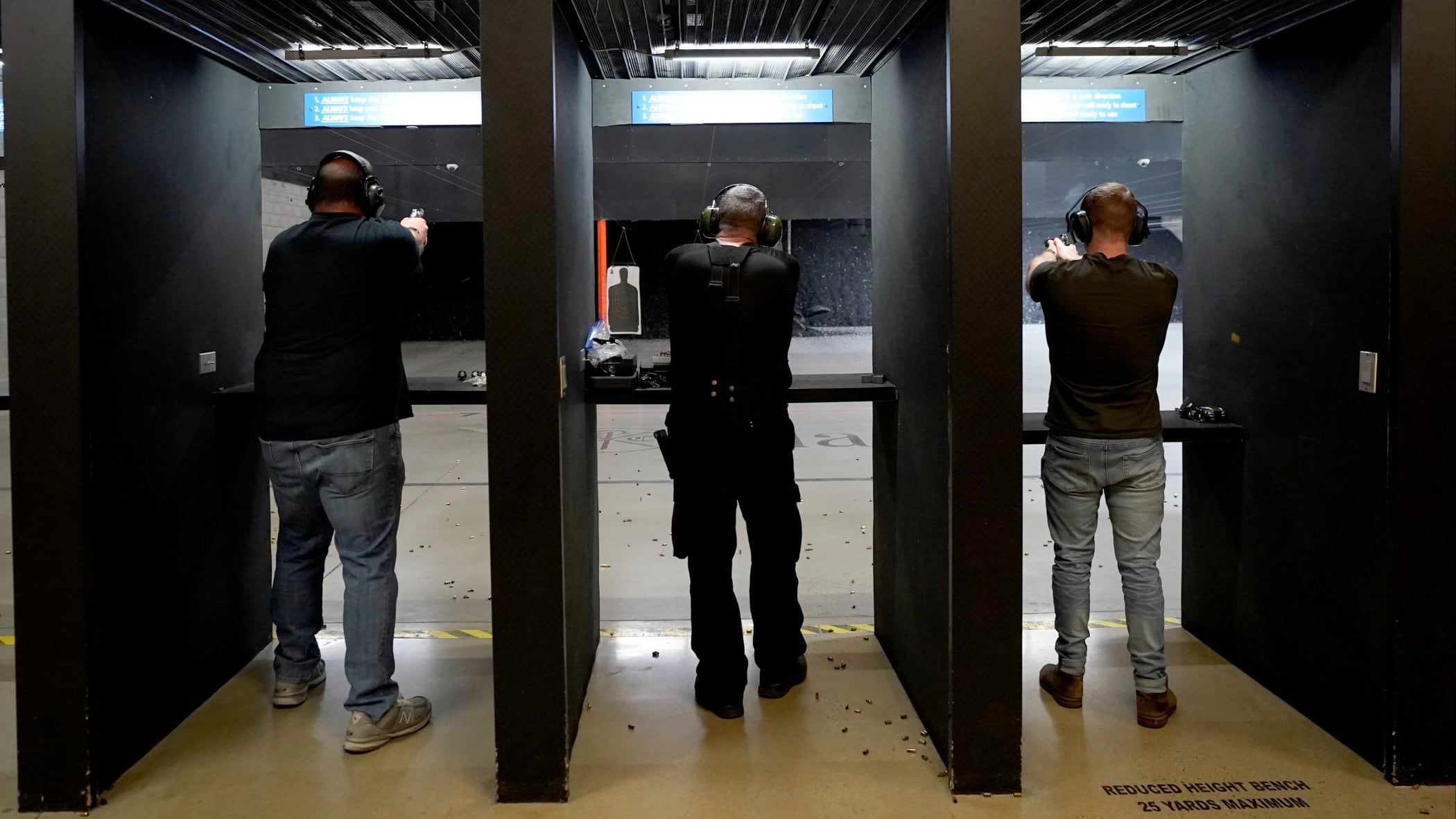
A California law that bans people from carrying firearms in most public places will take effect on New Year's Day, even as a court case continues to challenge the law.

A U.S. district judge issued a ruling Dec. 20 to block the law from taking effect, saying it violates the Second Amendment of the U.S. Constitution and deprives people of their ability to defend themselves and their loved ones.

But on Saturday, a federal appeals court put a temporary hold on the district judge's ruling. The appeals court decision allows the law to go into effect as the legal fight continues. Attorneys are scheduled to file arguments to the 9th Circuit Court of Appeals in January and in February.

The law, signed by Democratic Gov. Gavin Newsom, prohibits people from carrying concealed guns in 26 places including public parks and playgrounds, churches, banks and zoos.

The ban applies regardless of whether the person has a permit to carry a concealed weapon. One exception is for privately owned businesses that put up signs saying people are allowed to bring guns on their premises.

“This ruling will allow our common-sense gun laws to remain in place while we appeal the district court’s dangerous ruling," Newsom posted to X, formerly Twitter, after the appeals court acted Saturday. "Californians overwhelmingly support efforts to ensure that places like hospitals, libraries and children's playgrounds remain safe and free from guns.”

The California Rifle and Pistol Association sued to block the law. When U.S. District Judge Cormac Carney granted a preliminary injunction blocking the law, he wrote that the law was “sweeping, repugnant to the Second Amendment, and openly defiant of the Supreme Court.”

Carney wrote that gun rights groups are likely to succeed in proving it unconstitutional, meaning it would be permanently overturned.

The law overhauls California’s rules for concealed carry permits in light of the U.S. Supreme Court’s decision in New York State Rifle and Pistol Association v. Bruen, which set several states scrambling to react with their own laws. That decision said the constitutionality of gun laws must be assessed by whether they are “consistent with the nation’s historical tradition of firearm regulation.”

Newsom has said he will keep pushing for stricter gun measures.

Newsom has positioned himself as a national leader on gun control while he is being increasingly eyed as a potential presidential candidate. He has called for and signed a variety of bills, including measures targeting untraceable “ghost guns,” the marketing of firearms to children and allowing people to bring lawsuits over gun violence. That legislation was patterned on a Texas anti-abortion law.

California Attorney General Rob Bonta appealed Carney's decision. Bonta, a Democrat, said that if the district judge’s ruling to block the law were allowed to stand, it “would endanger communities by allowing guns in places where families and children gather.”

The California Pistol and Rifle Association’s president, Chuck Michel, said in a statement that under the law, gun permit holders “wouldn’t be able to drive across town without passing through a prohibited area and breaking the law.” Michel said criminals are deterred when law-abiding citizens can defend themselves.

Share:
More In Politics
Trump signs executive order to block state AI regulations
President Donald Trump has signed an executive order to block states from regulating artificial intelligence. He argues that heavy regulations could stifle the industry, especially given competition from China. Trump says the U.S. needs a unified approach to AI regulation to avoid complications from state-by-state rules. The order directs the administration to draw up a list of problematic regulations for the Attorney General to challenge. States with laws could lose access to broadband funding, according to the text of the order. Some states have already passed AI laws focusing on transparency and limiting data collection.
New York Times, after Trump post, says it won’t be deterred from writing about his health
The New York Times and President Donald Trump are fighting again. The news outlet said Wednesday it won't be deterred by Trump's “false and inflammatory language” from writing about the 79-year-old president's health. The Times has done a handful of stories on that topic recently, including an opinion column that said Trump is “starting to give President Joe Biden vibes.” In a Truth Social post, Trump said it might be treasonous for outlets like the Times to do “FAKE” reports about his health and "we should do something about it.” The Republican president already has a pending lawsuit against the newspaper for its past reports on his finances.
Trump approves sale of more advanced Nvidia computer chips used in AI to China
President Donald Trump says he will allow Nvidia to sell its H200 computer chip used in the development of artificial intelligence to “approved customers” in China. Trump said Monday on his social media site that he had informed China’s leader Xi Jinping and “President Xi responded positively!” There had been concerns about allowing advanced computer chips into China as it could help them to compete against the U.S. in building out AI capabilities. But there has also been a desire to develop the AI ecosystem with American companies such as chipmaker Nvidia.
Swing district Republicans brace for political fallout if health care subsidies expire
House Republicans in key battleground districts are working to contain the political fallout expected when thousands of their constituents face higher bills for health insurance coverage obtained through the Affordable Care Act. For a critical sliver of the GOP majority, the impending expiration of the enhanced premium tax credits after Dec. 31 could be a major political liability as they potentially face midterm headwinds in a 2026 election critical to President Donald Trump’s agenda. For Democrats, the party’s strategy for capturing the House majority revolves around pinning higher bills for groceries, health insurance and utilities on Republicans.
Trump says Netflix deal to buy Warner Bros. ‘could be a problem’ because of size of market share
President Donald Trump says a deal struck by Netflix last week to buy Warner Bros. Discovery “could be a problem” because of the size of the combined market share. The Republican president says he will be involved in the decision about whether federal regulators should approve the deal. Trump commented Sunday when he was asked about the deal as he walked the red carpet at the Kennedy Center Honors. The $72 billion deal would bring together two of the biggest players in television and film and potentially reshape the entertainment industry.
Load More