With the pandemic complicating life in a variety of ways, when it comes to food shopping, longer lines at the supermarket nears the top of the list of inconveniences for many people. On average, some shoppers spend one to two years of their lives waiting in line, and that was prior to social distancing guidelines.
Many stores have begun implementing self-checkout procedures, and while that certainly can reduce wait times, some markets do not have the capacity for those lanes, leaving store operators with two options: the multiple server, multi-single line set up, or the multiple server, single-line option.
And while the second option might seem physical longer, there are some reasons why the supermarket experience is shifting in that direction.
Multiple Server, Multi-Single Line Phase
The multiple server, multi-single line set up in supermarkets is perhaps the most familiar but also possibly the more chaotic, stress-inducing option. In this scenario, a customer chooses one of a multiple set of lines that ends up at one of the multiple cashiers.
It is not uncommon for a person to select a line they thought was moving faster only for the cashier or fellow shopper to run into an issue that slows the line down. As a result, a person that entered the line after you is already processing their order and headed for the exit.
In some instances, this triggers shoppers to jump from line to line, ultimately adding to the minutes they are standing in line.
It isn’t just the shopper’s stress and anxiety that heightens from selecting which line to enter. Cashiers also feel more pressure in these scenarios. They can see just how much a line is growing adding to the strain of completing transactions faster.
The Serpentine Line
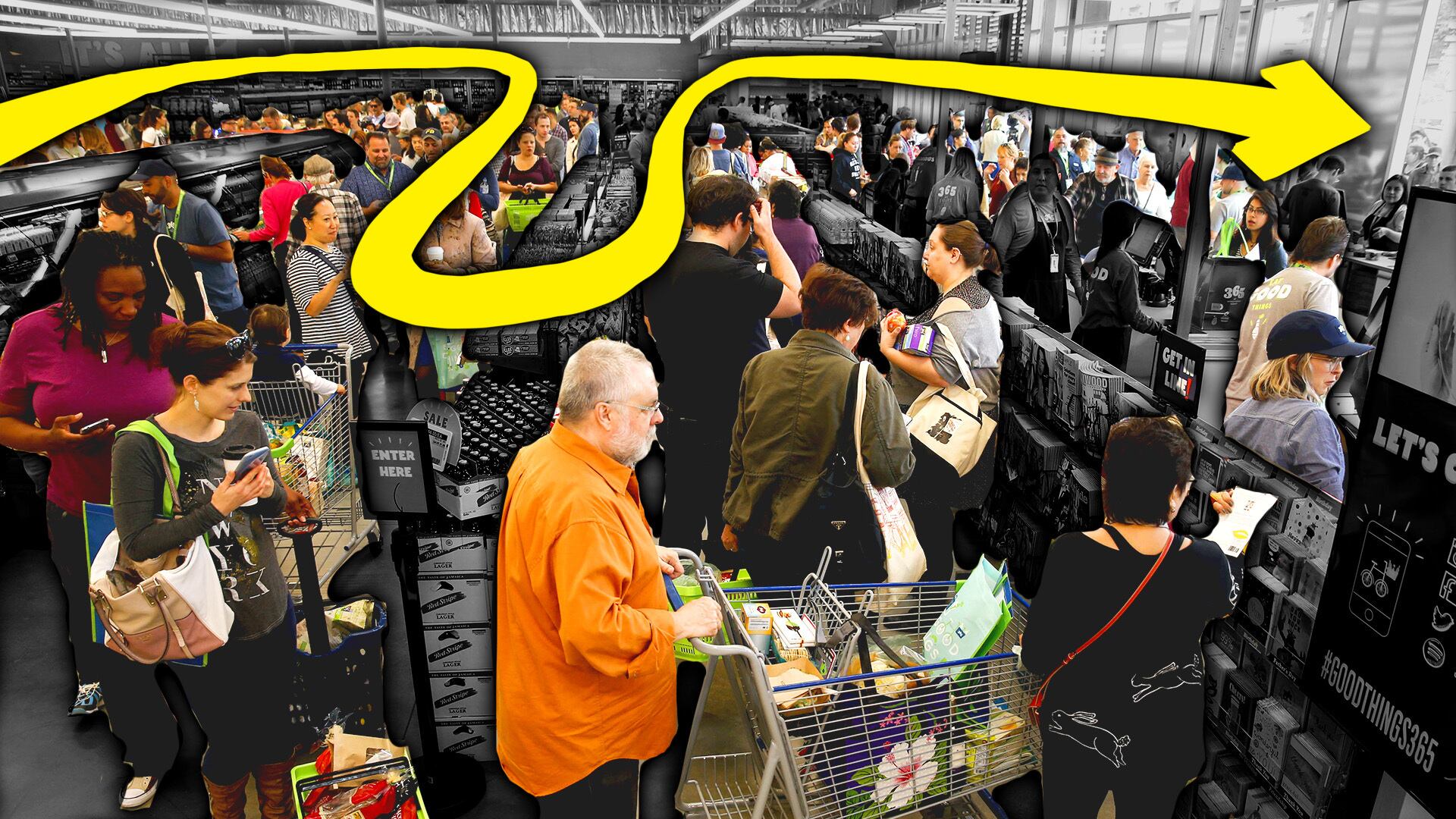
An alternative to the multiple-line format is the multiple server, single-line option, or the serpentine line. These lines are more commonly found in airports, banks, and theme parks where customers wait in one line and are then funneled to one of various cashiers or agents.
The serpentine line can create more of a sense of fairness among shoppers since each customer essentially waits the same amount of time, whereas, in the other set-up, the wait time can build resentment as the lines move at different paces.
However, there might be a drawback to the multiple server, single line phase. While cashiers feel the need to speed up their work in the traditional supermarket checkout, the serpentine formation can reduce a sense of urgency, and thus, the pace.
“What we found is that when we did almost the identical situation, but we changed it to a single line, the individual employees’ sense of responsibility to the customer went down,” Julie Niederhoff, queuing theory expert and associate professor at Syracuse University, told Cheddar.
Cashiers tend to work more slowly in the serpentine scenario, making wait times slightly longer. Still, for the customer, the experience can apparently be appreciated more.
Prioritizing the Customer Experience
As supermarket operators work to make the shopping experience more enjoyable and efficient, some are beginning to revamp the checkout process. Whole Foods, for example, has opted for the serpentine checkout. Other operators such as Trader Joe's and Stop & Shop have also followed suit.
While the snake-like line is technically longer and slower, it also can appear fairer and be much more accommodating when it comes to the limited space within a store. For businesses, it also allows for extra marketing opportunities. Strategically placing goods along the serpentine line checkout dramatically increases the chances that shoppers might continue to add to their baskets, and if shoppers aren’t adding additional items, then at least they can be distracted by those displays while ignoring the amount of time they stand in line.
Video produced by Christine Beldon and Ed Vega. Article written by Lawrence Banton.




