By Steve Peoples and Michelle L. Price
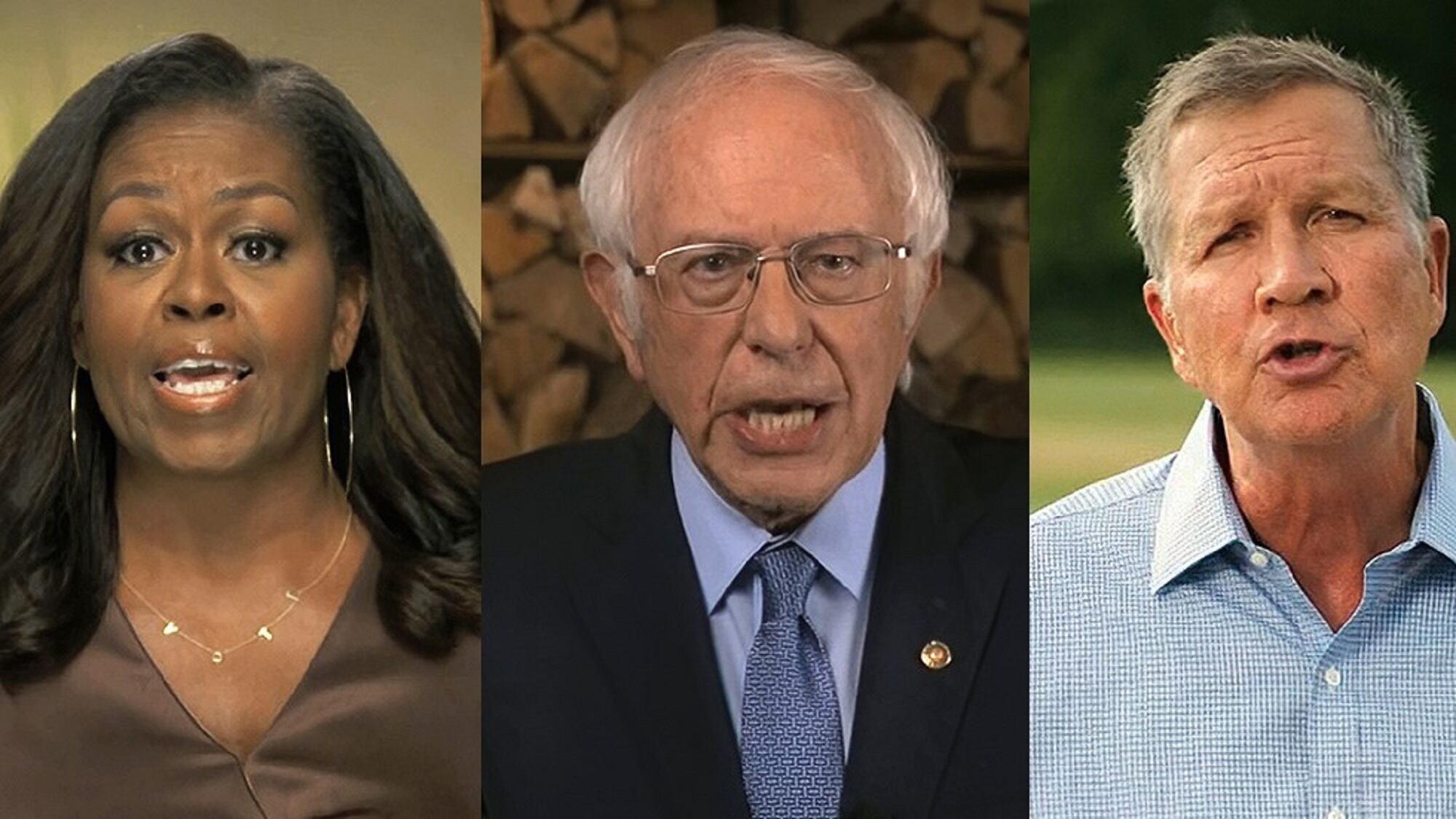
Michelle Obama delivered a passionate condemnation of President Donald Trump during the opening night of the Democratic National Convention, declaring him “in over his head” and warning that the nation's mounting crises would only get worse if he's reelected over Joe Biden.
“Donald Trump is the wrong president for our country,” she said. “He cannot meet this moment. He simply cannot be who we need him to be for us.”
The former first lady, one of the nation's most respected women, was the headliner at the first presidential nominating convention of the coronavirus era. There was no central meeting place or cheering throng during the all-virtual affair Monday night. But it was an opportunity for Democrats — and some Republicans — to rally behind Biden, the party's presidential nominee.
Bernie Sanders, the progressive Vermont senator who was Biden's last standing rival during the primary, encouraged his loyal supporters to vote for the former vice president in November, arguing the nation can't survive another four years of Trump. He notably backed Biden’s plan for tackling health care, one of their most substantive differences in the past. Sanders backs a Medicare for All plan while Biden has called for expanding the current “Obamacare” law.”
But it was Michelle Obama, making her fourth convention appearance, who once again delivered an electrifying moment. Wearing a necklace that said “vote,” she tapped into her enduring popularity among Black voters and college educated suburban women — voters Biden will need to show up in force.
She issued a stark warning to a country already navigating health and economic crises along with a reckoning on racism.
“If you think things possibly can’t get worse, trust me, they can and they will if we don’t make a change in this election,” she said as she issued a call to action for the coalition of young and diverse voters who twice sent her family to the White House.
Biden will formally accept the nomination on Thursday near his home in Wilmington, Delaware. His running mate, California Sen. Kamala Harris, who is the first Black woman on a national ticket, speaks Wednesday night.
Leading up to that, Biden sought on opening night to demonstrate the broad ideological range of his supporters.
On the same night he was praised by Sanders, a self-described democratic socialist who championed a multitrillion-dollar universal health care plan, Biden also won backing from Ohio’s former Republican Gov. John Kasich, an anti-abortion conservative who spent decades fighting to cut government spending.
“My friends, I say to you, and to everyone who supported other candidates in this primary and to those who may have voted for Donald Trump in the last election: The future of our democracy is at stake. The future of our economy is at stake. The future of our planet is at stake,” Sanders said as he endorsed Biden's health care plan.
Still, there were real questions about whether the prime-time event would adequately energize the disparate factions Biden hopes to capture.
Republicans face a similar challenge next week.
Trump sought to undermine the Democrats' big night by hosting a political rally in Wisconsin, where Biden's party had originally planned this week's convention. He called the Democrats' event “a snooze” before it even began.
Monday's speeches were framed by emotional appearances from average Americans touched by the crises that have exploded on Trump’s watch.
Philonise and Rodney Floyd led a moment of silence in honor of their brother, George Floyd, the Minnesota man whose death while in police custody sparked a national moment of awakening on racial injustice.
“George should be alive today,” Philonise Floyd said matter-of-factly.
Also speaking was Kristin Urquiza, an Arizona woman who lost her father to COVID-19, which has killed more than 170,000 people in the United States.
“My dad was a healthy 65-year-old,” she said. “His only preexisting condition was trusting Donald Trump, and for that, he paid with his life.”
And Rick Telesz, a Pennsylvania farmer, warned that Trump’s trade war has had a “truly a devastating effect” on his farm before the coronavirus brought another blow with what he called “misinformation” coming from the country’s leadership.
“My biggest concern is that if these trends continue with this type of leadership, I will be the last generation farming this farm,” he said.
Democrats abandoned their plans for an in-person gathering in Milwaukee because of the pandemic. The unprecedented gathering is not only testing the bonds of the diverse Biden-Harris coalition but the practical challenges of running a presidential campaign in the midst of a pandemic.
At this moment, Biden sits in a stronger political position than Trump, who has struggled to expand his political coalition under the weight of his turbulent leadership and prolonged health and economic crises. But 77 days before votes are counted, history is not on the Democratic challenger's side. Just one incumbent president has been defeated in the last four decades.
Polls also suggest that Biden, a 77-year-old lifelong politician, is on the wrong end of an enthusiasm gap. His supporters consistently say they're motivated more by opposition to Trump, who is 74, than excitement about Biden. Democrats hope to shift that dynamic beginning with the convention.
The former first lady, whom Gallup determined was the nation’s most admired woman last year, wowed Democrats at the 2016 presidential convention by coining the phrase: “When they go low, we go high.” She insisted on Monday she was not abandoning that tack, explaining that taking the high road doesn’t mean staying silent.
With no live audience for any of the speakers, convention organizers were forced to get creative in their high-stakes quest to generate enthusiasm. There were live appearances from speakers in Texas, South Carolina, Wisconsin and Michigan, but many of the speeches that aired Monday night were prerecorded.
Seeking to inject some family fun into an otherwise serious two-hour video montage, the campaign hosted drive-in viewing stations in six states, much like drive-in movies, where viewers could watch on a big screen from the safety of their vehicles. There were also many online watch parties featuring celebrities and elected officials to make the experience more interactive.
It was unclear how many people attended the parties. In most, only the speakers were visible on-screen. In one watch party, Washington Rep. Pramila Jayapal and Massachusetts Sen. Elizabeth Warren rallied progressives, many of whom had preferred Sanders over Biden.
“We must do everything we can to energize and excite our base about the choice before us,” Jayapal said
The Monday speakers included plenty of Democratic politicians: Rep. Jim Clyburn of South Carolina, who is the highest-ranking African American in Congress; New York Gov. Andrew Cuomo; Michigan Gov. Gretchen Whitmer; Alabama Sen. Doug Jones; Nevada Sen. Catherine Cortez Masto and two former presidential contenders: Minnesota Sen. Amy Klobuchar and Sanders.
And beyond Kasich, there were three high-profile Republicans backing Biden who got speaking slots: California businesswoman Meg Whitman, former New Jersey Gov. Christine Whitman and former New York congresswoman Susan Molinari.
It was impossible to fully gauge America's interest in the all-virtual format on the first night. Broadcast TV networks are showing the final hour each night live, cable news is showing both hours and many viewers plan to stream from the rivals' websites or on social media.
Trump, as he often does, was ensuring he'd be a part of the conversation.
The Republican president made two swing-state campaign appearances on Monday, first in Minnesota and then in Wisconsin, which was to be the location for the Democrats' convention before the coronavirus outbreak.
Trump said he had “no choice” but to campaign during the convention to address voters in the face of what he described as hostile news media.
“The only way we’re going to lose this election is if the election is rigged," Trump said in Wisconsin, raising anew with no evidence the specter of significant voting fraud.
Associated Press writer Kathleen Ronayne in California contributed to this report.