By Lauran Neergard

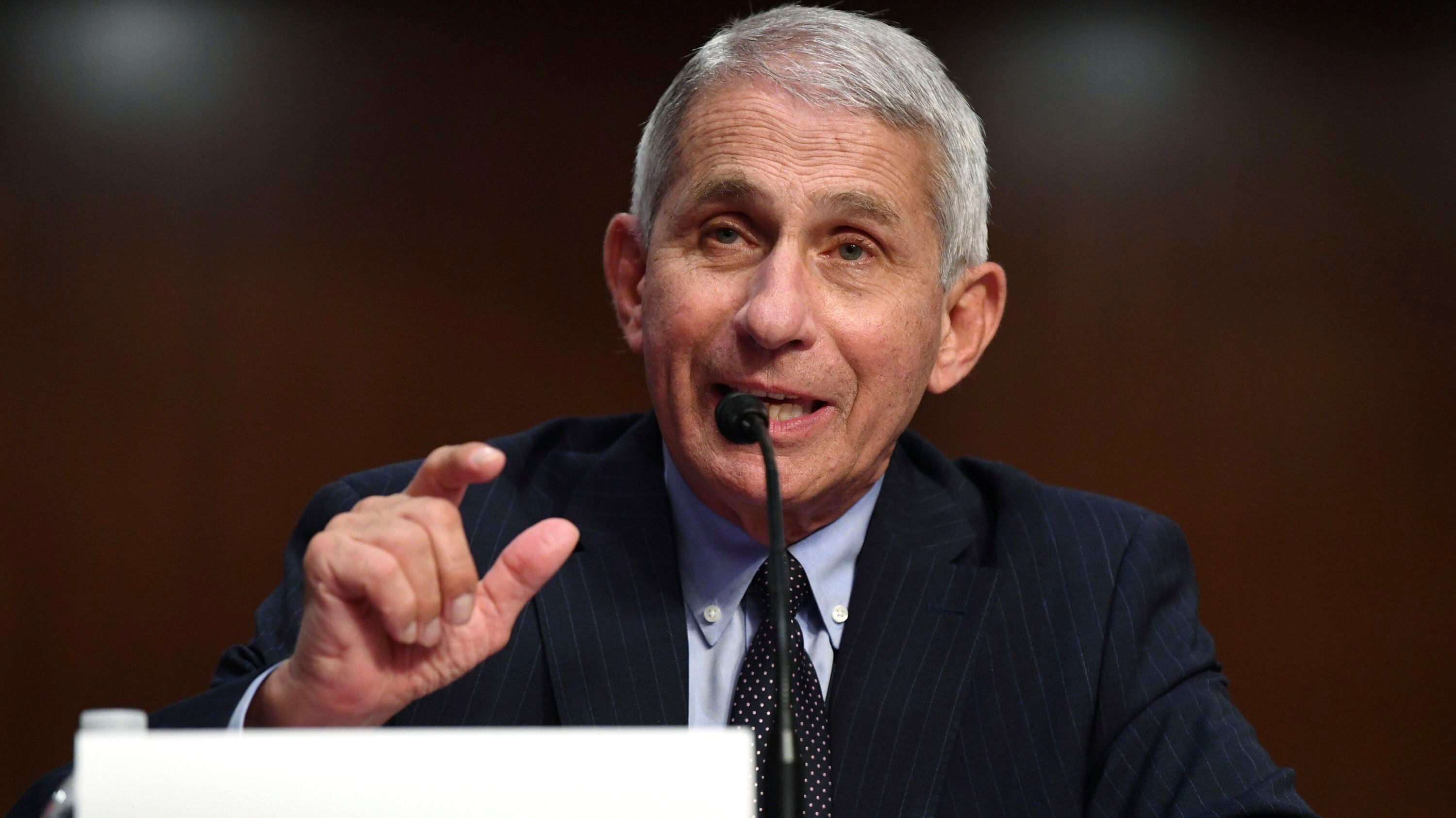
The U.S. is "going in the wrong direction" with the coronavirus surging badly enough that Dr. Anthony Fauci told senators Tuesday some regions are putting the entire country at risk — just as schools and colleges are wrestling with how to safely reopen.

With about 40,000 new cases being reported a day, Fauci, the government's top infectious disease expert, said he "would not be surprised if we go up to 100,000 a day if this does not turn around."

"I am very concerned," he told a hearing of the Senate Health, Education, Labor and Pensions committee.

Infections are rising rapidly mostly in parts of the West and South, and Fauci and other public health experts said Americans everywhere will have to start following key recommendations if they want to get back to more normal activities like going to school.

"We've got to get the message out that we are all in this together," by wearing masks in public and keeping out of crowds, said Fauci, infectious disease chief at the National Institutes of Health.

Connect the dots, he told senators: When and how school buildings can reopen will vary depending on how widely the coronavirus is spreading locally.

"I feel very strongly we need to do whatever we can to get the children back to school," he said.

The Centers for Disease Control and Prevention plans more guidelines for local school systems, Director Robert Redfield said.

But in recommendations for colleges released Tuesday, the agency said it won't recommend entry testing for all returning students, faculty, and staff. It's not clear if that kind of broad-stroke testing would reduce the spread of the coronavirus, CDC concluded. Instead, it urged colleges to focus on containing outbreaks and exposures as students return.

Lawmakers also pressed for what Sen. Patty Murray of Washington, the committee's top Democrat, called a national vaccine plan — to be sure the race for the COVID-19 vaccine ends with shots that really are safe, truly protect and are available to all Americans who want, one.

"We can't take for granted this process will be free of political influence," Murray said. She cited how President Donald Trump promoted a malaria drug as a COVID-19 treatment that ultimately was found to be risky and ineffective.

The Food and Drug Administration released guidelines Tuesday saying any vaccine that wins approval will have to be at 50 percent more effective than a dummy shot in the final, required testing. That's less effective than many of today's vaccines but independent experts say that would be a good start against the virus.

FDA Commissioner Stephen Hahn said vaccine makers also must test their shots in diverse populations, including minorities, the elderly, pregnant women, and those with chronic health problems.

"We will not cut corners in our decision-making," Hahn told senators.

About 15 vaccine candidates are in various stages of human testing worldwide but the largest studies — including 30,000 people each — needed to prove if a shot really protects are set to begin in July. First up is expected to be a vaccine created by the NIH and Moderna Inc., followed closely by an Oxford University candidate.

At the same time, the Trump administration's "Operation Warp Speed" aims to stockpile hundreds of millions of doses by year's end, so they could rapidly start vaccinations if and when one is proven to work.

Redfield said the CDC already is planning how to prioritize who is first in line for the scarce first doses and how they'll be distributed.

But a vaccine is at the very least many months away. For now, the committee's leading Republican stressed wearing a mask -- and said Trump, who notoriously shuns them, needs to start because politics is getting in the way of protecting the American people.

"The stakes are too high for the political debate about pro-Trump, anti-Trump masks to continue," said Sen. Lamar Alexander of Tennessee, who chaired Tuesday's hearing.

Alexander said he had to self-quarantine after a staff member tested positive for the virus but that he personally was protected because his staffer was wearing a mask.

"The president has plenty of admirers. They would follow his lead," Alexander said. "The stakes are too high" to continue that fight.

___

AP writers Ricardo Alonso-Zaldivar and Matthew Perrone in Washington, Collin Binkley in Boston, and Mike Stobbe in New York contributed to this report.

Share:
More In Politics
US tariffs are having an uneven effect on holiday prices and purchases
Many U.S. consumers say they’ve noticed higher than usual prices for holiday gifts in recent months, according to a a December poll from The Associated Press-NORC Center for Public Affairs Research. A contributing factor is the unusually high import taxes the Trump administration put on foreign goods. While the worst-case consumer impact that many economists foresaw from the administration’s trade policies hasn’t materialized, some popular gift items have been affected more than others. Most toys and electronics sold in the U.S. come from China. So do most holiday decorations. Jewelry prices have risen due to the cost of gold.
Serbia organized crime prosecutors charge minister, others in connection with Kushner-linked project
Serbia’s prosecutor for organized crime has charged a government minister and three others with abuse of position and falsifying of documents related to a luxury real estate project linked to U.S. President Donald Trump’s son-in-law Jared Kushner. The charges came on Monday. The investigation centers on a controversy over a a bombed-out military complex in central Belgrade that was a protected cultural heritage zone but that is facing redevelopment as a luxury compound by a company linked to Kushner. The $500 million proposal to build a high-rise hotel, offices and shops at the site has met fierce opposition from experts at home and abroad. Selakovic and others allegedly illegally lifted the protection status for the site by falsifying documentation.
Trump signs executive order to block state AI regulations
President Donald Trump has signed an executive order to block states from regulating artificial intelligence. He argues that heavy regulations could stifle the industry, especially given competition from China. Trump says the U.S. needs a unified approach to AI regulation to avoid complications from state-by-state rules. The order directs the administration to draw up a list of problematic regulations for the Attorney General to challenge. States with laws could lose access to broadband funding, according to the text of the order. Some states have already passed AI laws focusing on transparency and limiting data collection.
New York Times, after Trump post, says it won’t be deterred from writing about his health
The New York Times and President Donald Trump are fighting again. The news outlet said Wednesday it won't be deterred by Trump's “false and inflammatory language” from writing about the 79-year-old president's health. The Times has done a handful of stories on that topic recently, including an opinion column that said Trump is “starting to give President Joe Biden vibes.” In a Truth Social post, Trump said it might be treasonous for outlets like the Times to do “FAKE” reports about his health and "we should do something about it.” The Republican president already has a pending lawsuit against the newspaper for its past reports on his finances.
Trump approves sale of more advanced Nvidia computer chips used in AI to China
President Donald Trump says he will allow Nvidia to sell its H200 computer chip used in the development of artificial intelligence to “approved customers” in China. Trump said Monday on his social media site that he had informed China’s leader Xi Jinping and “President Xi responded positively!” There had been concerns about allowing advanced computer chips into China as it could help them to compete against the U.S. in building out AI capabilities. But there has also been a desire to develop the AI ecosystem with American companies such as chipmaker Nvidia.
Swing district Republicans brace for political fallout if health care subsidies expire
House Republicans in key battleground districts are working to contain the political fallout expected when thousands of their constituents face higher bills for health insurance coverage obtained through the Affordable Care Act. For a critical sliver of the GOP majority, the impending expiration of the enhanced premium tax credits after Dec. 31 could be a major political liability as they potentially face midterm headwinds in a 2026 election critical to President Donald Trump’s agenda. For Democrats, the party’s strategy for capturing the House majority revolves around pinning higher bills for groceries, health insurance and utilities on Republicans.
Load More