The House delivered the articles of impeachment against President Donald Trump to the Senate on Wednesday. The move finally came after a nearly month-long standoff between the Democratic House Speaker Nancy Pelosi and the Republican Senate Majority Leader Mitch McConnell.
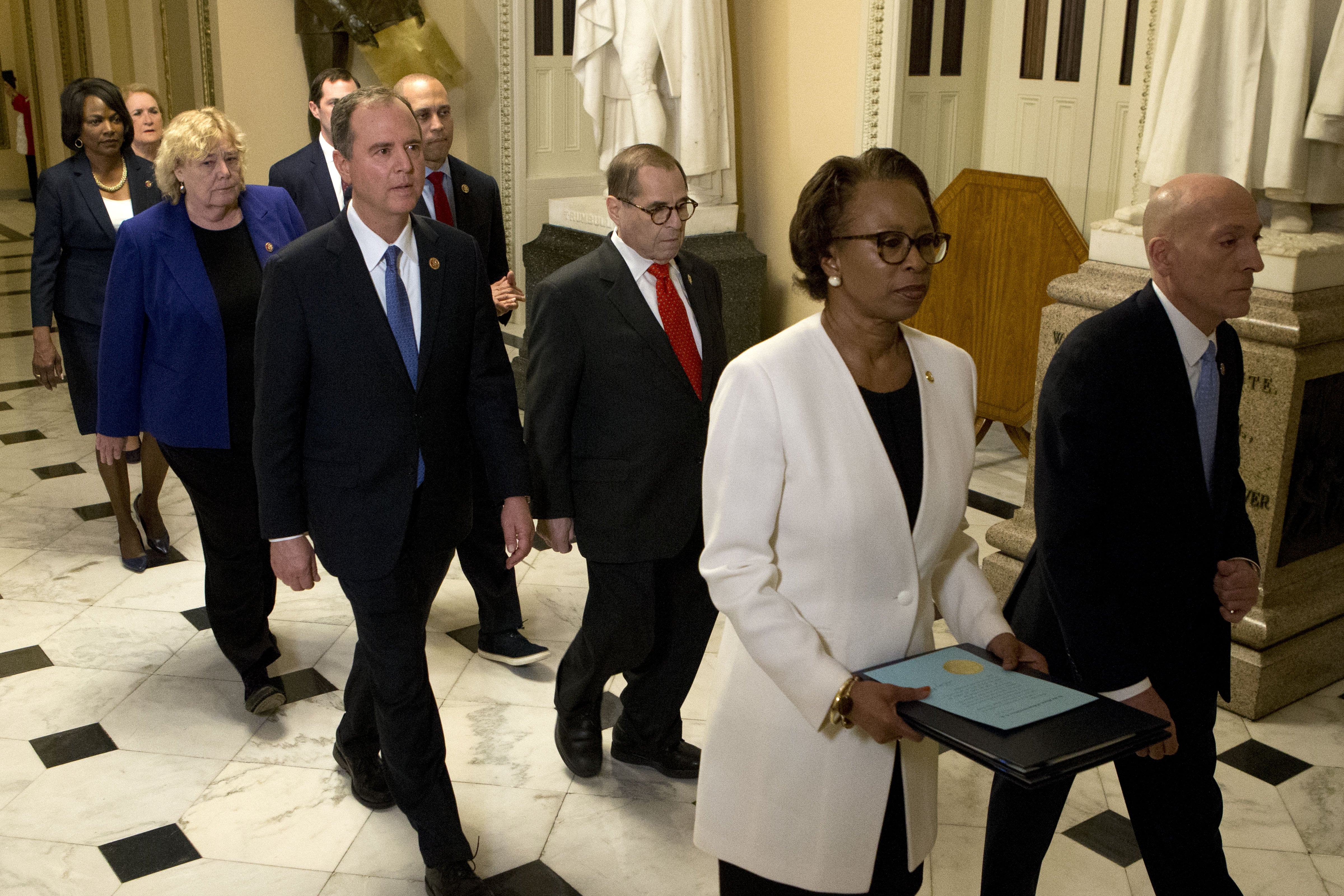
In a ceremonial “engrossment ceremony” Wednesday evening, Pelosi signed the articles of impeachment on a table covered by a navy blue tablecloth with #DefendOurDemocracy printed on the front. Impeachment managers then marched from the House chamber to the entrance of the Senate, delivering the articles to their counterparts.
Earlier in the day, Pelosi named the seven managers who will prosecute, including House Intelligence Committee Chairman Adam Schiff (D-Calif.) and House Judiciary Committee Chairman Jerry Nadler (D-N.Y.).
The Senate chamber is constitutionally charged with holding the trial, but McConnell has been clear: he plans to coordinate with the White House and says there is “zero chance” Trump will be removed from office.
The rules to govern the trial have not yet been set, and this is where McConnell is facing the greatest chance of party defection. Democrats have called on McConnell to allow new witnesses, especially in light of former National Security Adviser John Bolton recently indicating that he will now testify if subpoenaed, ending a monthslong standoff with a White House directive not to cooperate. Tuesday night, Democrats also released documents obtained from Lev Parnas, an associate of the president’s personal lawyer Rudy Giuliani. Parnas’ attorney confirmed his client wrote the note that said “get Zalensky to Announce that the Biden case will be Investigated.”
At least three senators, Lisa Murkoswki (R-Alaska), Mitt Romney (R-Ariz.) and Susan Collins (R-Maine), have indicated a willingness to listen to new witnesses, although none have committed to voting with Democrats on the rules. Sen. Lamar Alexander (R-Tenn.) has also indicated he’s willing to consider calling witnesses or accepting during the trial.
In a letter to Democratic colleagues Friday, the Speaker announced her plan to to transmit the articles of impeachment to the Senate this week.
“In an impeachment trial, every Senator takes an oath to do ‘impartial justice according to the Constitution and laws,’” she wrote, a thinly-veiled jab at McConnell who said “I am not an impartial juror” and Sen. Lindsay Graham (R-S.C.) who had said he had “clearly made up my mind.”
“Every Senator now faces a choice: to be loyal to the President or to the Constitution,” Pelosi continued in her letter. The U.S. Constitution gives Congress the sole power to hold politicians accountable by providing a process for removal of office. There have been 19 impeachment trials in U.S. history, but only two of those were for U.S. presidents -- Andrew Johnson in 1868 and Bill Clinton in 1999.
WHAT HAPPENS NEXT
Chief Justice John Roberts is expected in the Senate chamber Thursday where Senator Chuck Grassley (R-Iowa) will swear him in. Each senator will sign his or her name in a book when taking their oath. Once they are under oath, they’ll begin debate on rules of the trial. That’s when McConnell and Schumer will have the opportunity to suss out if and when new witnesses and documents will be allowed.
"Witnesses may tell the truth and witnesses may not tell the truth. Documents don’t generally lie,” said Schiff Wednesday as he was named an impeachment manager
When senators in 1999 debated to set the rules in Bill Clinton’s impeachment trial, they voted unanimously in favor of the agreed upon rules, which seems unlikely this time around.
Once that’s over, House managers and White House defense will likely have a few days to plan before the trial begins with both sides giving opening arguments. The trial is expected to begin in earnest Tuesday January 21. Senators will write in questions, which will be answered out loud. What comes next is not clear yet, but it will likely be interrupted by 2020 primary voting, which begins February 3 in Iowa, and the president’s February 4 State of the Union address.
WHO TO LOOK FOR
Just like in the impeachment inquiry, lawyers will steal the show. The president is expected to largely be defended by White House counsel Pat Cipollone and his personal lawyer Jay Sekulow. The Pelosi-assigned House Managers will present the case for removal.
“The emphasis is on litigators,” Pelosi said at a press conference Wednesday morning where she announced the managers. “The emphasis is in comfort level in the courtroom. The emphasis is on making the strongest case to protect our Constitution.”
The White House did not opt to offer a defense during the House investigation, so this will be the first time the public will hear from his team. Some outspoken Republicans who heartily defended the president during the House hearings, like Rep. Jim Jordan of Ohio, Rep. Doug Collins of Georgia and Rep. John Ratcliffe of Texas, may also have an opportunity to play a role in the trial.
Supreme Court Chief Justice John Roberts will preside over the trial and the 100 senators will largely remain silent as they act as jurors. During Clinton’s trial, senators were only able to submit written questions to then-Chief Justice William Rehnquist and witnesses were interviewed behind closed doors with records of the conversations made available to senators.
HOW WE GOT HERE
A whistleblower complaint filed last August sparked the impeachment inquiry. Though some Democrats had been agitating for an impeachment since Trump won the 2016 election, the whistleblower complaint raised actionable concerns: the source, who remains anonymous, claimed White House officials believed the president had abused his power for his own political benefit.
Ending months of caution, Pelosi announced in September the House would formally initiate an inquiry into the president’s conduct. Trump was accused of betraying his oath of office and endangering the nation’s security by withholding almost $400 million in security aid to Ukraine. Critics say he broke the law by pressuring Ukrainian President Volodymyr Zelensky to investigate former Vice President Joe Biden, the Democratic presidential frontrunner, and his son Hunter, who served on the board of Ukrainian national gas company Bursima Holdings.
However, after the White House released a rough transcript of a call at the center of the controversy, the president said it was a “perfect” call, though national security and foreign policy experts, most of them bureaucrats, not political appointees, testified under oath about their concerns over the president’s actions.
On December 18, the House voted to impeach the president on two counts: abuse of power and obstruction of Congress. Now it comes down to the Senate. Two-thirds of the Senate must vote to remove the president from office. With 53 Republicans currently serving in the Senate, and a Majority Leader of whom he has unwavering support, to many, it appears his fate is all but sealed.