By Farnoush Amiri
The House voted late Tuesday to censure Democratic Rep. Rashida Tlaib of Michigan — the only Palestinian American in Congress — an extraordinary rebuke of her rhetoric about the Israel-Hamas war.
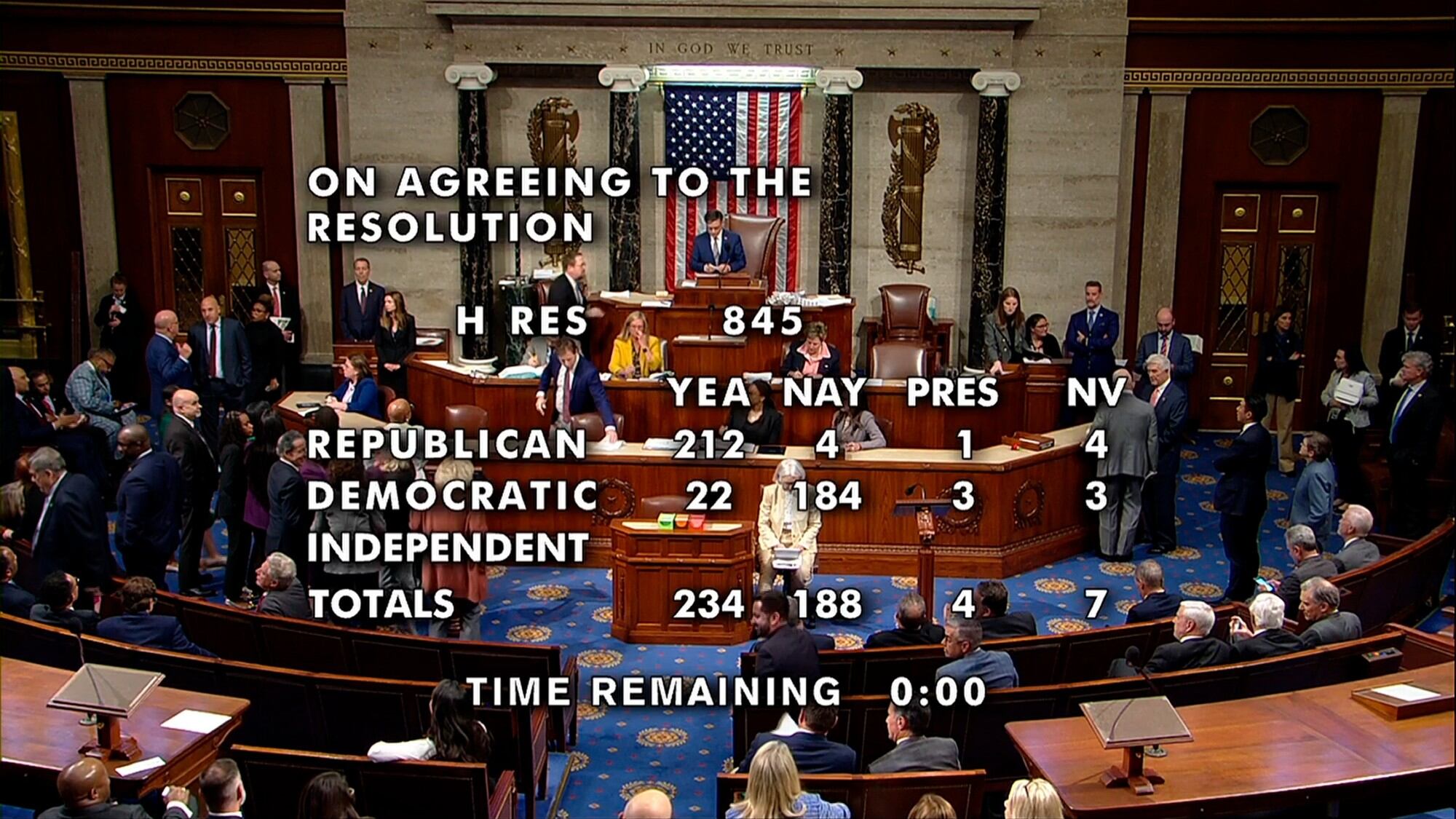
The 234-188 tally came after enough Democrats joined with Republicans to censure Tlaib, a punishment one step below expulsion from the House. The three-term congresswoman has long been a target of criticism for her views on the decades-long conflict in the Middle East.
The debate on the censure resolution on Tuesday afternoon was emotional and intense. Republican Rep. Rich McCormick of Georgia pushed the measure in response to what he called Tlaib’s promotion of antisemitic rhetoric. He said she has “levied unbelievable falsehoods about our greatest ally, Israel, and the attack on October 7.”
With other Democrats standing by her side, Tlaib defended her stance, saying she “will not be silenced and I will not let you distort my words.” She added that her criticism of Israel has always been directed toward its government and its leadership under Prime Minister Benjamin Netanyahu.
“It is important to separate people and government,” she said. “The idea that criticizing the government of Israel is antisemitic sets a very dangerous precedent. And it’s been used to silence diverse voices speaking up for human rights across our nation.”
That criticism reached new heights after the Oct. 7 attack by the terrorist group Hamas left hundreds of Israelis dead and scores injured. Tlaib, who has family in the West Bank, came under heavy reproval after she failed to immediately condemn Hamas after the attack.
All Democrats initially stood by Tlaib and helped defeat the first censure resolution against her last week. But since then, many of her colleagues, including prominent Jewish members, have become more conflicted about her rhetoric about the war, especially because of a slogan she has used frequently that is widely seen as calling for the eradication of Israel.
Ultimately, more than 20 of them joined Republicans on Tuesday night to censure her after an effort to shelve the measure failed earlier in the day.
The latest censure push resulted in a dramatic vote on the House floor amid political tensions over the ongoing, deadly Israel-Hamas war. While the majority of both parties have historically stood firmly on the side of Israel, divisions have emerged in the Democratic Party about the American response.
Rep. Brad Schneider, D-Ill., the lone Democrat to vote with Republicans on Tuesday to advance the censure resolution, said he believed it was important to debate the slogan “from the river to the sea.”
“It is nothing else but the call for the destruction of Israel and murder of Jews,” the Jewish Democrat said. “I will always defend the right to free speech. Tlaib has the right to say whatever she wants.”
He added, “But it cannot go unanswered.”
While the censure of a lawmaker carries no practical effect, it amounts to severe reproach from colleagues, as lawmakers who are censured are usually asked to stand in the well of the House as the censure resolution against them is read aloud. But the resolution against Tlaib did not call for the public admonishment.
With the vote, Tlaib will become the second Muslim-American woman in Congress to be formally admonished this year for her criticism of Israel. Rep. Ilhan Omar, D-Minn., was removed in February from the House Foreign Affairs Committee for similar comments she made about Israel.
Some on the left have criticized President Joe Biden’s stance and urged him to put conditions on U.S. support for Israel as its aggressive military campaign drives the Palestinian death toll higher.
While the vote against Tlaib will take place against the extraordinary backdrop of the war, the push to censure her is part of a growing pattern in the House.
Censure had long been viewed as a punishment of last resort, just one step below expulsion and to be triggered only for the most egregious wrongdoing. But censure resolutions are quickly becoming routine in the chamber, often wielded in strikingly partisan ways.
Many Democrats and some Republicans who opposed censuring Tlaib cited free speech and warned of the precedent it would set.
“This resolution not only degrades our Constitution, but it cheapens the meaning of discipline in this body for people who actually commit wrongful actions like bribery, fraud, violent assault and so on,” said Rep. Jamie Raskin, D-Md., who defended Tlaib against the resolution on the floor late Tuesday.
A second resolution by Rep. Marjorie Taylor Greene, R-Ga., to censure Tlaib had also been scheduled for a procedural vote late Tuesday night. But that measure was put on hold after the censure resolution from McCormick advanced to a final vote.
Tlaib is now the 26th person to ever be censured by the chamber, and the second just this year. In June, Republicans voted to censure Democrat Adam Schiff of California for comments he made several years ago about investigations into then-President Donald Trump’s ties to Russia.
When the House was under Democratic control, Republican Rep. Paul Gosar of Arizona was censured in 2021 for tweeting an animated video that depicted him striking Democratic Rep. Alexandria Ocasio-Cortez of New York with a sword. And Democratic Rep. Charlie Rangel of New York was censured in 2010 over serious financial and campaign misconduct.
AP Congressional Correspondent Lisa Mascaro contributed to this report.