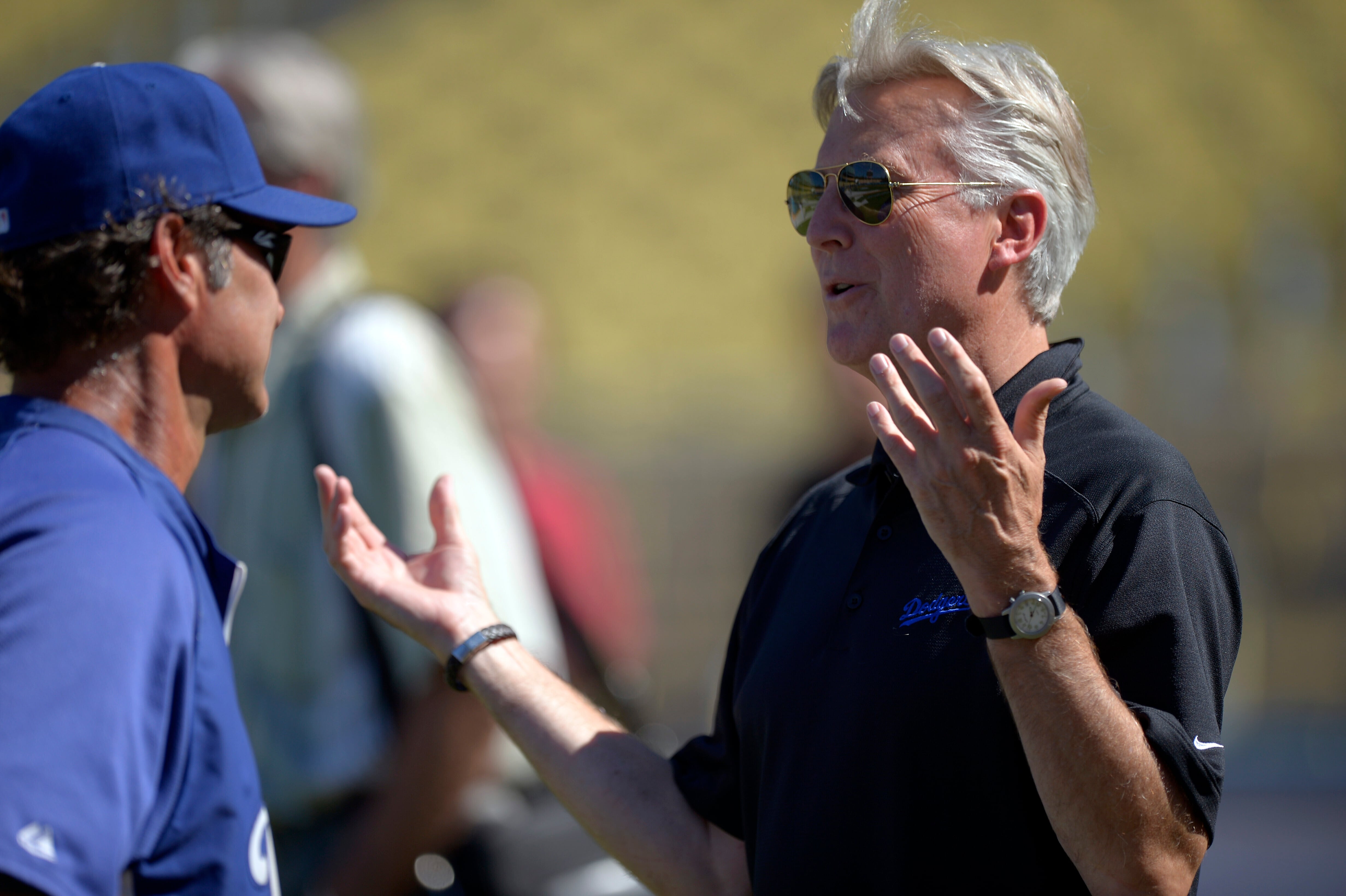
FILE - Los Angeles Dodgers co-owner Mark Walter, right, talks with manager Don Mattingly prior to their baseball game against the San Diego Padres, Sept. 3, 2012, in Los Angeles. (AP Photo/Mark J. Terrill, File)
The billionaire slated to take over the controlling interest in the Los Angeles Lakers has built a career leading businesses investing in everything from sports franchises to artificial intelligence.
Mark Walter is CEO of the global investment and advisory company Guggenheim Partners, which is estimated to have more than $325 billion in assets. He’s also co-founder and CEO of holding company TWG Global.
Forbes estimates Walter’s net worth is $6.1 billion. The publication ranked him at No. 216 on its Forbes 400 list last year.
Walter received an undergraduate degree in business administration from Creighton University and a law degree from Northwestern University, but ultimately chose business over a career in law.
In the mid-1990s, he co-founded Liberty Hampshire, an investment management firm in Chicago. That business became part of Guggenheim Partners, which Walter co-founded in the late 1990s.
In addition to Guggenheim, Walter co-founded TWG Global with entrepreneur and investor Thomas Tull. The company holds a portfolio of finance and insurance sector companies, including Guggenheim Investments, Guggenheim Securities, Group 1001 Insurance and Delaware Life. It also includes aerospace and defense technology company Shield AI.
Last month, TWG Global announced a partnership with Palantir Technologies and Elon Musk’s AI company, xAI, maker of Grok, aimed at developing artificial intelligence for use in the financial services industry.
TWG Global also includes investments in sports, media and entertainment franchises, such as the controlling interest in the Los Angeles Dodgers, Premier League club Chelsea, the Professional Women’s Hockey League and — through TWG Motorsports — ownership of several auto racing teams including Cadillac Formula 1.
Beyond business, Walter and his wife, Kimbra, have founded or contributed to various philanthropic organizations, including the Los Angeles Dodgers Foundation, the Academy Group, Chicago Beyond and OneGoal.
The New York Times and President Donald Trump are fighting again. The news outlet said Wednesday it won't be deterred by Trump's “false and inflammatory language” from writing about the 79-year-old president's health. The Times has done a handful of stories on that topic recently, including an opinion column that said Trump is “starting to give President Joe Biden vibes.” In a Truth Social post, Trump said it might be treasonous for outlets like the Times to do “FAKE” reports about his health and "we should do something about it.” The Republican president already has a pending lawsuit against the newspaper for its past reports on his finances.
OpenAI has appointed Slack CEO Denise Dresser as its first chief of revenue. Dresser will oversee global revenue strategy and help businesses integrate AI into daily operations. OpenAI CEO Sam Altman recently emphasized improving ChatGPT, which now has over 800 million weekly users. Despite its success, OpenAI faces competition from companies like Google and concerns about profitability. The company earns money from premium ChatGPT subscriptions but hasn't ventured into advertising. Altman had recently announced delays in developing new products like AI agents and a personal assistant.
President Donald Trump says he will allow Nvidia to sell its H200 computer chip used in the development of artificial intelligence to “approved customers” in China. Trump said Monday on his social media site that he had informed China’s leader Xi Jinping and “President Xi responded positively!” There had been concerns about allowing advanced computer chips into China as it could help them to compete against the U.S. in building out AI capabilities. But there has also been a desire to develop the AI ecosystem with American companies such as chipmaker Nvidia.
U.S. sports betting is booming as NFL and college football fuel massive activity. BetMGM CEO Adam Greenblatt breaks down trends, growth, and what’s next.
President Donald Trump says a deal struck by Netflix last week to buy Warner Bros. Discovery “could be a problem” because of the size of the combined market share. The Republican president says he will be involved in the decision about whether federal regulators should approve the deal. Trump commented Sunday when he was asked about the deal as he walked the red carpet at the Kennedy Center Honors. The $72 billion deal would bring together two of the biggest players in television and film and potentially reshape the entertainment industry.
Disney's changes to a program for disabled visitors are facing challenges in federal court and through a shareholder proposal. The Disability Access Service program, which allows disabled visitors to skip long lines, was overhauled last year. Disney now mostly limits the program to those with developmental disabilities like autism who have difficulty waiting in lines. The changes have sparked criticism from some disability advocates. A shareholder proposal submitted by disability advocates calls for an independent review of Disney's disability policies. Disney plans to block this proposal, claiming it's misleading. It's the latest struggle by Disney to accommodate disabled visitors while stopping past abuses by some theme park guests.
With a merger this big, creators, studios, and theaters all face uncertain futures. Here’s what experts are worried about and what good could come from it.
With disengagement rising and hybrid work shifting, 'Everybody Matters' author Bob Chapman explains why treating people well could define the future of work.
We sat down with Ali Furman, U.S. Consumer Markets Industry Leader at consulting firm PwC to ask what trends she garnered from the initial data this year.