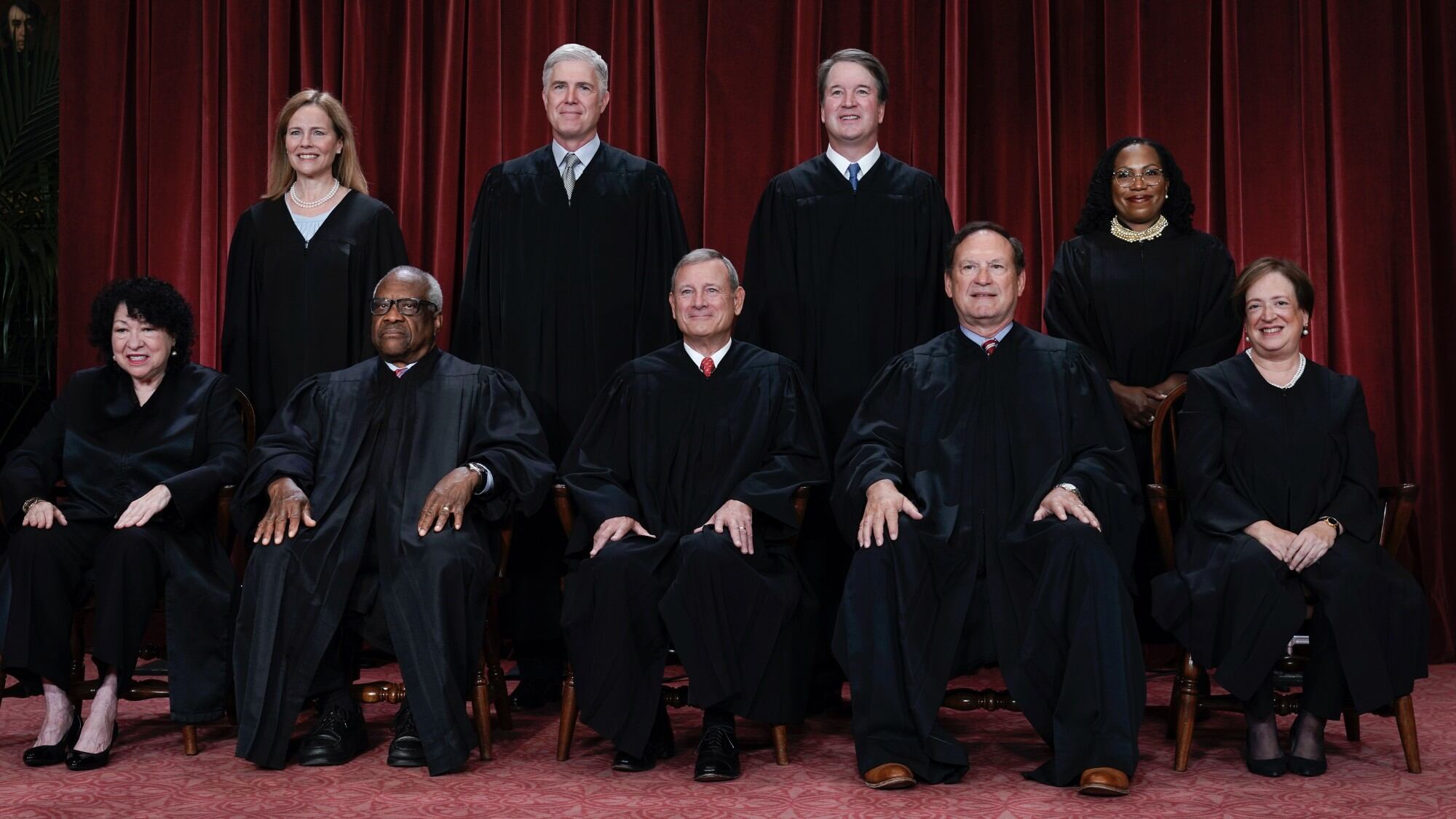
By Mark Sherman
Overturning Roe v. Wade and eliminating affirmative action in higher education had been leading goals of the conservative legal movement for decades.
In a span of 370 days, a Supreme Court reshaped by three justices nominated by President Donald Trump made both a reality.
Last June, the court ended nationwide protections for abortion rights. This past week, the court’s conservative majority decided that race-conscious admissions programsat the oldest private and public colleges in the country, Harvard and the University of North Carolina, were unlawful.
Precedents that had stood since the 1970s were overturned, explicitly in the case of abortion and effectively in the affirmative action context.
“That is what is notable about this court. It’s making huge changes in highly salient areas in a very short period of time,” said Tara Leigh Grove, a law professor at the University of Texas.
As ethical questions swirled around the court and public trust in the institution had already dipped to a 50-year low, there were other consequential decisions in which the six conservatives prevailed.
They rejected the Biden administration's $400 billion student loan forgiveness program and held that a Christian graphic artist can refuse on free speech grounds to design websites for same-sex couples, despite a Colorado law that bars discrimination based on sexual orientation and other characteristics.
The court, by a 5-4 vote, also sharply limited the federal government's authority to police water pollution into certain wetlands, although all nine justices rejected the administration's position.
Affirmative action was arguably the biggest constitutional decision of the year, and it showcased fiercely opposing opinions from the court's two Black justices, Clarence Thomas and Ketanji Brown Jackson.
They offered sharply contrasting takes on affirmative action. Thomas was in the majority to end it. Jackson, in her first year on the court, was in dissent.
The past year also had a number of notable surprises.
Differing coalitions of conservative and liberal justices ruled in favor of Black voters in an Alabama redistricting case and refused to embrace broad arguments in a North Carolina redistricting case that could have left state legislatures unchecked and dramatically altered elections for Congress and president.
The court also ruled for the Biden administration in a fight over deportation priorities and left in place the Indian Child Welfare Act, the federal law aimed at keeping Native American children with Native families.
Those cases reflected the control that Chief Justice John Roberts asserted, or perhaps reasserted, over the court following a year in which the other five conservatives moved more quickly than he wanted in some areas, including abortion.
Roberts wrote a disproportionate share of the term's biggest cases: conservative outcomes on affirmative action and the student loan plan, and liberal victories in Alabama and North Carolina.
The Alabama case may have been the most surprising because Roberts had consistently sought to narrow the landmark Voting Rights Act since his days as a young lawyer in the Reagan administration. As chief justice, he wrote the decision 10 years ago that gutted a key provision of the law.
But in the Alabama case and elsewhere, Roberts was part of majorities that rejected the most aggressive legal arguments put forth by Republican elected officials and conservative legal advocates.
The mixed bag of decisions almost seemed designed to counter arguments about the court's legitimacy, raised by Democratic and liberal critics — and some justices — in response to last year's abortion ruling, among others. The narrative was amplified by published reports of undisclosed, paid jet travel and fancy trips for Justices Clarence Thomas and Samuel Alito from billionaire Republican donors.
“I don’t think the court consciously takes opinion into account,” Grove said. “But I think if there’s anyone who might consciously think about these issues, it’s the institutionalist, the chief justice. He’s been extremely concerned about the attacks on the Supreme Court.”
On the term's final day, Roberts urged the public to not mistake disagreement among the justices for disparagement of the court. “Any such misperception would be harmful to this institution and our country,” he wrote in the student loans case in response to a stinging dissent by Justice Elena Kagan.
Roberts has resisted instituting a code of ethics for the court and has questioned whether Congress has the authority to impose one. Still, he has said, without providing specifics, that the justices would do more to show they adhere to high ethical standards.
Some conservative law professors rejected the idea that the court bowed to outside pressures, consciously or otherwise.
“There were a lot of external atmospherics that really could have affected court business, but didn't,” said Jennifer Mascott, a George Mason University law professor.
Curt Levey, president of the Committee for Justice, pointed to roughly equal numbers of major decisions that could be characterized as politically liberal or conservative.
Levey said conservatives “were not disappointed by this term.” Democrats and their allies “warned the nation about an ideologically extreme Supreme Court but wound up cheering as many major decisions as they decried,” Levey wrote in an email.
But some liberal critics were not mollified.
Brian Fallon, director of the court reform group Demand Justice, called the past year “another disastrous Supreme Court term” and mocked experts who “squint to find so-called silver linings in the Court’s decisions to suggest all is not lost, or they will emphasize one or two so-called moderate decisions from the term to suggest the Court is not as extreme as we think and can still be persuaded from time to time.”
Biden himself said on MSNBC on Thursday that the current court has “done more to unravel basic rights and basic decisions than any court in recent history.” He cited as examples the overturning of abortion protections and other decisions that had been precedent for decades.
Still, Biden said, he thought some on the high court “are beginning to realize their legitimacy is being questioned in ways it hasn’t been questioned in the past.”
The justices are now embarking on a long summer break. They return to the bench on the first Monday in October for a term that so far appears to lack the blockbuster cases that made the past two terms so momentous.
The court will examine the legal fallout from last year's major expansion of gun rights, in a case over a domestic violence gun ban that was struck down by a lower court.
A new legal battle over abortion also could make its way to the court in coming months. In April, the court preserved access to mifepristone, a drug used in the most common method of abortion, while a lawsuit over it makes its way through federal court.
The conservative majority also will have opportunities to further constrain federal regulatory agencies, including a case that asks them to overturn the so-called Chevron decision that defers to regulators when they seek to give effect to big-picture, sometimes vague, laws written by Congress. The 1984 decision has been cited by judges more than 15,000 times.
Just seven years ago, months before Trump's surprising presidential victory, then-Justice Ruth Bader Ginsburg reflected on the term that had just ended and made two predictions. One was way off base and the other was strikingly accurate.
In July 2016, the court had just ended a term in which the justices upheld a University of Texas affirmative action plan and struck down state restrictions on abortion clinics.
Her first prediction was that those issues would not soon return to the high court. Her second was that if Trump became president, “everything is up for grabs.”
Ginsburg's death in 2020 allowed Trump to put Justice Amy Coney Barrett on the court and cement conservative control.
Commenting on the student loan decision, liberal legal scholar Melissa Murray wrote on Twitter that Biden's plan “was absolutely undone by the Court that his predecessor built.”