Russian and Ukrainian delegations resumed talks on Monday following failed attempts to begin evacuating civilians from besieged Ukrainian cities, including the port city of Mariupol.
After the first two attempts failed over the weekend, Russia announced yet another limited cease-fire that would allow desperate civilians to flee encircled cities through humanitarian corridors, though there was no word as of Monday night that shelling had stopped.
Meanwhile, Ukrainian President Volodymyr Zelenskyy urged his people to keep resisting the assault, which U.N. officials say has forced more than 1.7 million to flee Ukraine. Zelenskyy also called for a global boycott of all Russian products, including oil.
Here’s a look at key things to know about the war:
ANY PROGRESS ON SAFE EVACUATIONS?
After the weekend efforts to establish safe passage for civilians fell apart amid continued shelling, with each side blaming the other, the Russian Defense Ministry said Monday that civilians would be allowed to leave the capital Kyiv, Mariupol, Kharkiv and Sumy.
Moscow proposed evacuation routes that would lead mostly to Russia and its ally Belarus, which Ukraine rejected as unacceptable.
The two sides held a third round of talks Monday, with Zelenskyy advisor Mykhailo Podolyay reporting that progress was made on the evacuations matter and that he hopes the safe corridors will be “fully functional” starting Tuesday. However, he said no progress was made toward a political settlement that would end the war.
The countries’ foreign ministers are also scheduled to meet in Turkey on Thursday, according to that country’s top diplomat.
WHAT ELSE IS HAPPENING ON THE GROUND?
Ukrainian officials said Russia stepped up its shelling of several major cities on Sunday night, including Kyiv.
Russian forces launched hundreds of missiles and artillery attacks, dropping powerful bombs on residential areas of Chernihiv, a city north of Kyiv, Ukrainian officials said. But a long Russian armored column threatening Kyiv remained stalled.
On Sunday evening, Mykolaiv in the south and Kharkiv, the country’s second-largest city, were also shelled.
Ukrainian forces were also defending Odesa, Ukraine’s largest port city, from Russian ships, Ukrainian presidential adviser Oleksiy Arestovich said.
Meanwhile, Ukraine’s foreign minister said more than 20,000 people from 52 countries have volunteered to fight in Ukraine’s new international legion.
ZELENSKYY PUSHES CALL FOR NO-FLY ZONE
Zelenskyy continued to call on foreign countries to impose a no-fly zone over Ukraine. Establishing a no-fly zone would risk escalating the conflict by involving foreign militaries directly. Although the U.S. and many other Western countries have backed Ukraine with weapons shipments, they have not sent troops and have rejected the calls for a no-fly zone.
Zelenskyy said in a video address on Sunday that “the world is strong enough to close our skies,” and over the weekend he urged U.S. officials help his country obtain warplanes to fight the invasion and retain control of its airspace.
Russian Defense Ministry spokesman Igor Konashenkov said Sunday that some Ukrainian warplanes had redeployed to Romania and other Ukraine neighbors he didn’t identify. He warned that an attack from planes operating out of those nations could be deemed an engagement by them in the conflict.
U.S. Deputy Secretary of State Wendy Sherman said Monday in Madrid, where she met with Spain's foreign minister, that getting military material to Ukrainians is set to become more difficult. She said the Biden administration is considering how to fulfill Zelenskyy’s request for warplanes, considering that Ukrainians would only be able to operate Soviet-era aircraft provided by Poland.
DIRECTLY WITNESSED OR CONFIRMED BY THE ASSOCIATED PRESS
In Mariupol, Red Cross officials on Monday were waiting to find out whether a safe corridor had been established to evacuate civilians. Most of the shelling of the besieged city has remained on its outskirts, but shells have also fallen at random in all areas.
The situation has become increasingly desperate in the city, with shortages of food, water, and power, and some looting that police have ignored. There is no mobile phone service, so accurate news has become a valuable commodity and rumors abound.
Even hospitals have shortages of antibiotics and painkillers, and doctors have been performing some emergency procedures without them.
Police were advising people to remain in shelters until they hear official messages broadcast over loudspeakers telling them to evacuate.
In the northern city of Kharkiv, meanwhile, Dmitry Sedorenko described the desperate scramble after his apartment block was struck Monday amid heavy shelling.
“I think it struck the fourth floor under us,” Sedorenko said. “Immediately, everything started burning and falling apart. It became smoky and difficult to see and then the floor fell through. We crawled out of the third floor. There were dead people. We got lucky.”
In Kyiv, the central train station remained crowded with people desperate to leave, and frequent shelling could be heard from the city's center.
WHAT'S HAPPENING WITH DIPLOMATIC EFFORTS
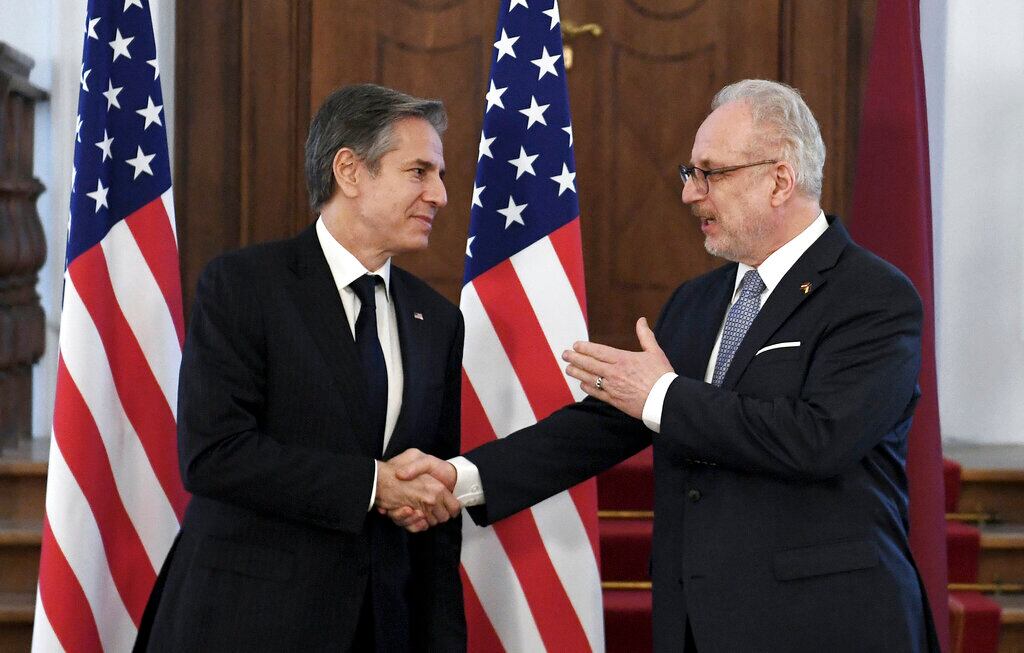
U.S. Secretary of State Antony Blinken visited Lithuania and Latvia on Monday to calm any fears that they and Estonia, which he'll visit Tuesday, have about their security in the event Russia expands its military operations. The three Baltic countries, which endured decades of Soviet occupation before regaining their independence in 1991, are members of the EU and NATO.
Blinken stressed that the U.S. commitment to NATO’s mutual defense pact is “sacrosanct” and that NATO and the U.S. were discussing stationing troops in the Baltics permanently.
The New Zealand government, meanwhile, said it plans to fast track legislation that will allow it to impose economic sanctions against Russia.
China’s foreign minister called Russia Beijing’s “most important strategic partner" and has continued to refuse to condemn the invasion of Ukraine.
French President Emmanuel Macron is one of the few world leaders who has kept an open line of communication to Putin. In an interview Monday with French news broadcaster LCI, however, Macron criticized Moscow's offer to open humanitarian corridors to Russia for Ukrainian civilians. “This is cynicism” that is “unbearable,” he said.
Meanwhile, Russian lawyers snubbed a hearing at the United Nations’ top court about Ukraine's effort to halt the invasion.
THE HUMANITARIAN SITUATION
The death toll of the conflict has been difficult to measure. The U.N. human rights office said Monday that it had confirmed the deaths of 406 civilians and wounding of 801 others through the end of Sunday. However, it said it thinks the actual figures are considerably higher.
The World Health Organization said it verified at least six attacks that have killed six health care workers and injured 11 others.
Ukrainian refugees continue to pour into neighboring countries, including Poland, Romania and Moldova. Among them are an unknown number of people with U.S. citizenship, though some haven't been able to flee Ukraine yet.
The number of people who have left Ukraine since fighting began has reached 1.7 million, according to the U.N. refugee agency.
BUSINESS IN RUSSIA
A growing number of multinational businesses have cut Russia off from vital financial services, technology and a variety of consumer products in response to Western economic sanctions and global outrage over the war.
Two of the so-called big four accounting firms — KPMG and PricewaterhouseCoopers — said Sunday that they were pulling out of Russia, ending relationships with member firms based in the country.
TikTok said users won’t be able to post new videos in Russia in response to the government’s crackdown on what people can say on social media about the invasion, and American Express announced it was suspending all operations in Russia and Belarus.
Netflix also announced it was suspending its service in Russia.
Updated on March 7, 2022, at 2:22 p.m. ET with the latest details.