Cheddar is partnering with StackCommerce to bring you the Cheddar Shop. This article doesn’t constitute editorial endorsement, and we earn a portion of all sales.

Working from home has its perks, but there are a few negatives we all have to navigate. Be it extraneous noise, constant interruptions, or family members making cameos on Zoom, our home office setups can be less than ideal. In fact, for many remote workers, one of the biggest productivity pitfalls is the lack of a multi-monitor desktop layout. To which we say, if your company isn’t springing for those expensive (not to mention bulky) computer screens, why should you?

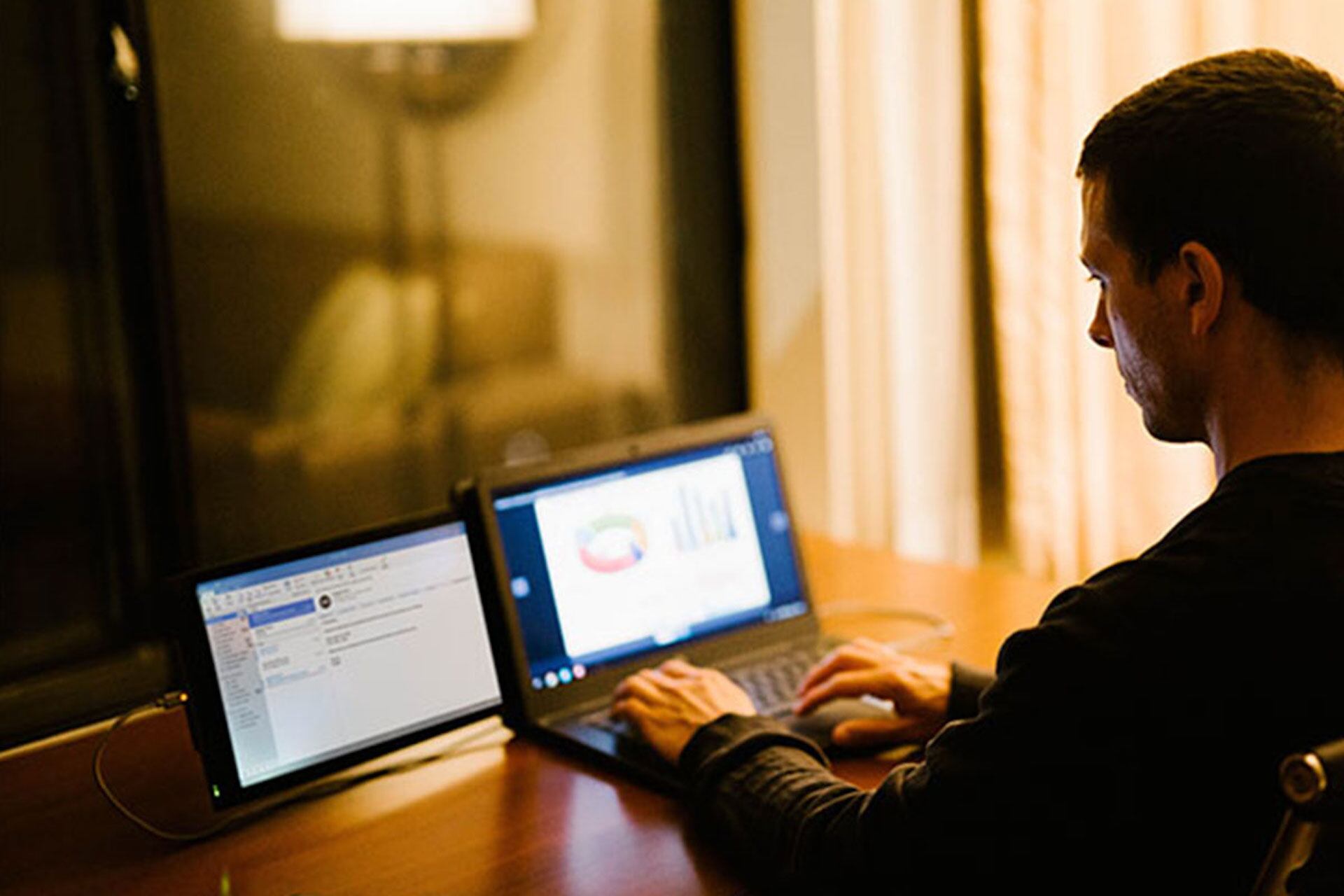
Beat the system with the Mobile Pixels DUEX Pro Portable Dual Monitor, now available for $69 off with code SAVEDUEXPRO. This smart accessory attaches to any laptop, adding a second screen in seconds, wherever you may be working from. A crowdfunded product, the internet saw all its brilliant benefits and helped raise over an impressive $1 million in funding on Indiegogo.

While it’s seamless to use, this portable monitor is anything but basic. The 1080p screen delivers sharp, clear graphics. You can easily adjust the positioning, with 270-degree rotation and dual-sided sliding. There’s even a 180-degree presentation mode, which will come in handy for your next in-person meeting. 

Let the multitasking fun begin. Move between screens with ease, whether you’re working on that big presentation or taking a little gaming break (it happens). Distractions aside, this monitor will help you reach your next deadline early; expect your productivity to increase by 50 percent when you're in dual-monitor mode

The Mobile Pixels DUEX Pro Portable Dual Monitor normally costs $249 at full price, but you can get it for $180, or $69 off, with code SAVEDUEXPRO at checkout. 

Share:
More In Technology
Spain fines Airbnb $75 million for unlicensed tourist rentals
Spain's government has fined Airbnb 64 million euros or $75 million for advertising unlicensed tourist rentals. The consumer rights ministry announced the fine on Monday. The ministry stated that many listings lacked proper license numbers or included incorrect information. The move is part of Spain's ongoing efforts to regulate short-term rental companies amid a housing affordability crisis especially in popular urban areas. The ministry ordered Airbnb in May to remove around 65,000 listings for similar violations. The government's consumer rights minister emphasized the impact on families struggling with housing. Airbnb said it plans to challenge the fine in court.
Militant groups are experimenting with AI, and the risks are expected to grow
The Islamic State group and other militant organizations are experimenting with artificial intelligence as a tool to boost recruitment and refine their operations. National security experts say that just as businesses, governments and individuals have embraced AI, extremist groups also will look to harness the power of AI. That means aiming to improve their cyberattacks, breaking into sensitive networks and creating deepfakes that spread confusion and fear. Leaders in Washington have responded with calls to investigate how militant groups are using AI and seek ways to encourage tech companies to share more about how their products are being potentially misused.
Trump signs executive order to block state AI regulations
President Donald Trump has signed an executive order to block states from regulating artificial intelligence. He argues that heavy regulations could stifle the industry, especially given competition from China. Trump says the U.S. needs a unified approach to AI regulation to avoid complications from state-by-state rules. The order directs the administration to draw up a list of problematic regulations for the Attorney General to challenge. States with laws could lose access to broadband funding, according to the text of the order. Some states have already passed AI laws focusing on transparency and limiting data collection.
San Francisco woman gives birth in a Waymo self-driving taxi
Waymo's self-driving taxis have been in the spotlight for both negative and positive reasons. This week, the automated ride-hailing taxis went viral after a San Francisco woman gave birth inside a Waymo taxi while on her way to the hospital. A Waymo spokesperson on Wednesday confirmed the unusual delivery. It said the company's rider support team detected unusual activity inside the vehicle and alerted 911. The taxi arrived safely at the hospital before emergency services. Waymo's popularity is growing despite heightened scrutiny following an illegal U-turn and the death of a San Francisco cat. The company, owned by Alphabet, says it is proud to serve riders of all ages.
OpenAI names Slack CEO Dresser as first chief of revenue
OpenAI has appointed Slack CEO Denise Dresser as its first chief of revenue. Dresser will oversee global revenue strategy and help businesses integrate AI into daily operations. OpenAI CEO Sam Altman recently emphasized improving ChatGPT, which now has over 800 million weekly users. Despite its success, OpenAI faces competition from companies like Google and concerns about profitability. The company earns money from premium ChatGPT subscriptions but hasn't ventured into advertising. Altman had recently announced delays in developing new products like AI agents and a personal assistant.
Trump approves sale of more advanced Nvidia computer chips used in AI to China
President Donald Trump says he will allow Nvidia to sell its H200 computer chip used in the development of artificial intelligence to “approved customers” in China. Trump said Monday on his social media site that he had informed China’s leader Xi Jinping and “President Xi responded positively!” There had been concerns about allowing advanced computer chips into China as it could help them to compete against the U.S. in building out AI capabilities. But there has also been a desire to develop the AI ecosystem with American companies such as chipmaker Nvidia.
Load More